Le Mans Series – Silverstone – Saturday Morning
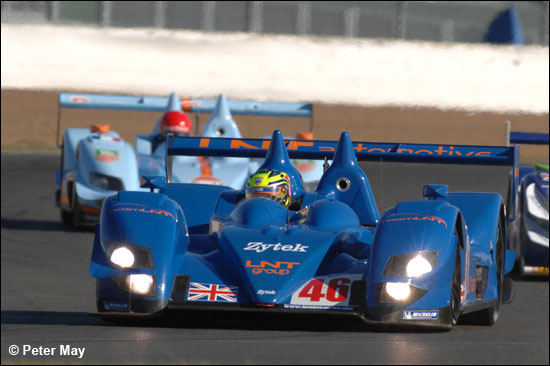
LNT Zytek Third Fastest Overall In the rush we probably didn’t mention the weather yesterday, but Saturday morning is more of the same – that is, fine and bright, pleasantly warm, just about perfect in fact. All those traffic comments yesterday… well, Paul Truswell spotted why the track was so busy, beside the fact that there are 46 cars here for this event. Apart from the #51 Larbre Aston Martin, every car covered more than 20 laps in the second session – and we make that a grand total of 1,248 laps completed in the hour. Divide 3,600 seconds by that number of laps and we’ve got a car passing any spot on the track every 2.9 seconds. That’s traffic. And that’s causing problems, trying to work out the relative pace of different cars. Short of asking every team whether they’ve had a clear lap or not – they almost certainly haven’t – we won’t really know how things stand until qualifying. But there are some details emerging – and the story here this morning is the pace of Danny Watts and Tom Kimber-Smith in the LNT Zytek. Watts was out first at 09.30, on yesterday’s rubber, and he returned with a fabulous 1:37.300 against his name. “I was so at home in the car, and the Zytek people have been incredibly helpful. When someone gives you the right package….. I’m really enjoying this. We want to get some more mileage on the car though, because we’re learning all the time.” The car did stop out on the track, briefly, but fired up again: electrical, possibly to do with the gearchange, it was thought. Here’s Danny Watts, talking to the similarly-sized (height anyway) Graham Tyler. By the end of the session, Tom Kimber-Smith looked almost dazed at what he’d achieved. He’d set a 1:37.441 on the same tyres that Watts had used, and then a 1:36.008 on new rubber. “And I lost a lot of time through the last sector. On my last run yesterday I felt confident in the car for the first time, and now today I feel totally at home in it.” The suggestion is that the #46 car is actually faster than the Peugeots through the Becketts sweepers. The Zytek was third fastest overall, behind the two Peugeots. The diesel cars were both in the 34s, so we haven’t been given a taste of their real form yet. As it was earlier in the season, that pace will doubtless become apparent in qualifying. Here's a traffic moment yesterday involving the #7 908, Neil Cunningham in the Embassy Radical holding his line, the Peugeot then spinning across the kerbs. Jonathan Cochet joined TK-S in the 1:36s, with a 1:36.561, best of the P1 cars – then it was another P2, Tommy Erdos in the RML MG Lola. He preceded a whole group of cars in the 37s and 38s, the P1s being the #16 Pescarolo, the Creation, the other works Pescarolo, Bob Berridge in the Chamberlain-Synergy Lola, the Charouz Lola and the Rollcentre Pescarolo. The Arena Zytek had an off somewhere, and only managed six laps in the session: Tom Chilton was the guilty party, apparently, and there was damage to the 07S. Was Jan Charouz concerned about the #15 car’s pace? “No, we’ve looked at our best theoretical time in that session and it would have been a 1:36. It’s the traffic.” Bob Berridge was much happier with his 1:38. “We made a change two races ago and it didn’t work. I demanded that we changed it back.” That worked then, the #19 two seconds faster than it was yesterday. There was also a big gain with the Creation Autosportif entry. “They made massive changes to the set-up, again, last night, and it’s better in every way,” said a much happier Jamie C-W. “We’ve now only got a little bit of mid-corner understeer, but it’s responding well to the changes.” This is Haruki Kurosawa at the wheel this morning. In the course of conversation with JC-W, the subject of the Creation’s pole time in 2005 cropped up, when Nic Minassian set a 1:34.562. JC-W had some very interesting remarks to make on the relative performance of P1 and P2 cars here at Silverstone. “That was with the 675 car, in 2005. That car felt like a single seater through the fast sweepers after Copse. That section is ideal for P2 cars, with their lower weight. So is the whole complex at the end of the lap. And it helps them that the corners onto the straights are typically fast ones – even at Club where we’re trying to get the power down and control the weight transfer, but they’re just driving out of the corner. They’re also later onto the brakes than we are, thanks again to their light weight.” So there we have it, JC-W’s explanation for the pace of the P2s here. The times in GT1 didn’t seem especially significant – but it was the Team Modena Aston Martin fastest again, with Jack Leconte’s #50 Aston Martin second. “I was quickest this morning, so I’m happy,” commented Darren Turner, who spent his rack time yesterday settling back into the DBR9. The #72 Alphand Corvette didn’t run with fresh rubber, the team fighting a handling issue at the back of the car, which might be related to the dampers being used, which are different from the ones on the Corvette Racing C6.Rs. GT2
For the GT2 runners, this morning was another chance to experiment with settings in order to find an ideal race setup. At least, that was the theory. For the Felbermayr team, problems with tyres that were losing air spoiled their session. For much of the early part of the session, the #77 car was quickest, in the hands of Marc Lieb, who set a time of 1m 50.941s, while the chief opposition, the Virgo Ferrari #96, was out on used Dunlops with Gianmaria Bruni at the wheel. Gimmi came in just after half way through the session and reported that he was “very happy with the way everything was going”. It is clear that he has slotted seamlessly in to the team, and Rob Bell, the team’s regular driver is quite content with his new co-driver. Later on in the session, Rob was given a new set of tyres, and immediately took the F430GT to the top of the GT2 times, with a 1m 50.159, the fastest time for a GT2 car of the weekend so far. Felbermayr, represented by ‘Super-Xavier’ Pompidou, were unable to improve in the second half of the session. Time was lost while Pirelli technicians investigated the cause of the deflating tyres. In the last 10 minutes of the session, Pompidou lost control of the Porsche going through the second, right-handed part of the Becketts esses and spun into the gravel. When he got the car back to the pits, the team found that the tyre pressure on the left-rear was down, and the Frenchman was convinced that it had been the cause of his off. “Superficially, there doesn’t appear to be any damage,” said team manager Hugh Hayden. “But we will be checking the car carefully before qualifying. GT2 pole in qualifying is not a priority,” Hayden went on, “but we don’t want to be in the ‘risk zone’ for the start of the race.” Over at Spyker Squadron, the times were again looking promising. The #85 car wound up third fastest after Peter Dumbreck went out on new Dunlop tyres at the end of the session. However, the Scot was complaining about too much oversteer. “We have been concentrating on a set up for qualifying this morning,” he said, “but we will have to get more understeer into the car tomorrow morning, as the car will not be easy to drive over a race stint”. Second fastest yesterday in Free Practice, the IMSA Performance Porsche of Raymond Narac and Richard Lietz, ended up only fifth in this morning’s hour-long session. Narac had a touch with another car, and damaged a wheel, the car finishing with a time less than half-a-second slower than yesterday. But the GT2 class is so closely matched that the top three cars were within one second, and the top seven separated by just two seconds. Johnny Mowlem (sixth fastest this morning in GT2) explains that “we’ve been forced to go for a harder tyre than the one we’d like to use. We can’t make the medium last over a stint, so having been fourth fastest yesterday on the mediums, we’ll sacrifice three or four places on the grid to ensure we have a better race tyre.” The sister GPC Ferrari has a 2007 engine and exhaust system, the #83 car has 2006 parts. Piers Masarati is much happier this morning, having felt a little race rusty yesterday (in the Farnbacher Porsche). “We’re in the ballpark, although we’re not really happy with the balance of the car yet.” The qualifying session will last just 20 minutes, starting at 2:10pm, and will be for the GT cars only, which will reduce the traffic problem, one hopes. “The problem is the slow GT2 cars, though,” said Rob Bell, who will drive the Virgo Ferrari during Qualifying. “They can be all over the place”. In the grand scheme of things though, the importance of qualifying for a 1,000km race is not that great, I suggested: “You’d be surprised, actually,” said Bell. “If there are a couple of Porsches ahead of you at the start of the race, it they can get pretty wide and it can take more than ten laps to get by.” Somehow I think the race might be a bit longer than that, and from where I’m sitting, it looks to me like only clever strategy and a bit of luck is going to enable anyone to beat the Virgo Ferrari. Of course, clever strategy is what it is all about, and the three hours of Free Practice we have witnessed over the last two days will have seen enormous amounts of data collected, and the teams will have a number of different plans that they can put into operation over the course of the race. One of the problems for the GT2 cars is not even knowing how long the race will be. “We have a member of the team, whose job it is to watch the overall lead of the race, and predict how long it will take the Peugoets to complete the 196 lap race distance, ” says Rob Bell. “Of course if the Peugeots slow down, or have a problem, it means that we have a longer race. We have to be in a position to change our strategy to deal with the way that the race unfolds.” Hugh Hayden, from the Felbermayr-Proton team says, “we have been collecting data on fuel consumption throughout practice. With different engine mappings, we can affect the amount of fuel that the car uses, and that enables us to catch up on the pit stops.” It’s up to the driver to select which mapping is used at any point, which he does in consultation with the team. “Communication is key,” says Hayden, “we need to make sure the drivers talk to us – and ours do, fortunately, so we feel like we’re in the car with them!” Whatever happens in Qualifying, it promises to be a fascinating race.
PT |