Weekend Conclusions
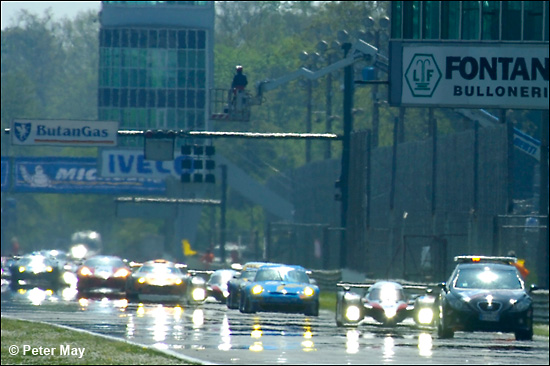
From Following Long Beach and Monza On The TV That’s Motors TV of course – and with the Editor (revived after a two week or so break) at base for his first weekend back, Motors TV provided seven hours of ‘endurance’ racing – live. What a treat. That provided a wonderful opportunity to compare and contrast two series which, in theory, run to the same rules – and with one race finishing at 01.40 local time (here in the UK) on Sunday morning, and the next starting just over ten hours later, it was an immediate opportunity to do so, with just a few hours sleep between. 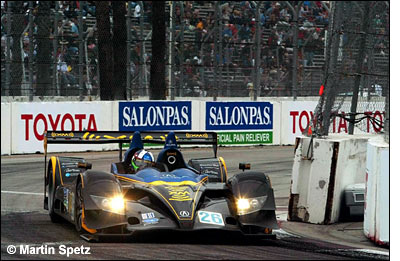 Mark Cole was on Motors TV duties for both races, supported on Sunday by David Leslie and Carlton Kirby. At one point during Sunday’s Monza broadcast, the three of them compared LMP2 in the two series, but oddly, failed to mention the fact that the ALMS cars run larger restrictors than their European counterparts.
Here, in P2, was an immediate difference between the two series: Monza (a classic old track) had that clear differentiation between LMP1 and LMP2, while Long Beach (a classic street track) ended up with the P2 cars finishing first through sixth. The P2 winner at Monza, the Horag Racing Lola Judd, was sixth overall – and it was a car that had raced at PLM, Laguna Seca and Sebring, but without making an impression at any of those events (largely because it wasn’t running the larger restrictors [boost] of its ALMS opposition). Meanwhile, Long Beach was largely dominated by the Porsche and Acura P2 cars (certainly in the results) – while at Monza, Peugeot played the ‘R10 at Le Mans’ role and utterly dominated proceedings. Just suppose for a moment that Peugeot didn’t have any LMP1 rivals at Monza (much as Audi doesn’t really in the ALMS): the two 908s would have finished first and second, two laps apart, with the winner eight laps ahead of the P2 winner – and had the IMSA officials not decided to stick with larger P2 restrictors for this year, that would be the pattern in the ALMS for 2007, wouldn’t it? The Porsche and Acura P2 cars would keep the gap to something less than eight laps over five hours of racing – but even so, diesel LMP1 form on both sides of the Atlantic (in the 2006 ALMS, at Le Mans last year and at Monza last Sunday) point to the fact that IMSA made absolutely the right decision to refrain from adopting the ACO’s restrictor changes. But Peugeot did have its LMP1 rivals at Monza, although the writing was on the wall once the 908s showed their real form in qualifying. The pole to third gap was almost 1.7 seconds in qualifying, and 1.5 seconds (to the same car, the Charouz Lola Judd) in the race – although taking #8’s best sector times, that gap was within one thousandth of a second of two seconds (1:36.013 vs. 1:38.012). Endorsing that IMSA restrictor decision again, Emanuele Pirro did manage to pass the Andretti Green Acura at Long Beach, on top speed, although the circuit, apart from the long blast past the pits on Shoreline Drive, was hardly conducive to Audi R10 form – although there were only three or four tenths between the best laps of the faster Audi and the best times from the Porsche and Acura cars (the P2s were faster). So in a nutshell we had an ALMS race in which the best P2 cars were slightly faster than the Audi R10s, while in the LMS we had the Peugeots running up to two seconds faster than the best of their P1 rivals, and more like three seconds faster than most of the rest, on typical race pace (for the #8 at least, as Lamy / Sarrazin made up ground after their gear shift problem). That sets the scene for the two races – and it was the ALMS one, with its grid not much more than half the size of the Monza one, and running for one-third of the duration, which made for the better TV. Was the ALMS race improved by that ‘conveniently’ timed Safety Car period – or spoiled by it? It’s hard to know, but the timing certainly created some drama at the end. Had Timo Bernhard driven for more than 30 minutes? Had Romain Dumas driven for more than 70 minutes? The officials decided that Bernhard had and Dumas hadn’t, and so the result stood – but the timing of the SC period certainly counted against Audi, with Capello appearing to do something that at first glance seemed very odd (pitting as the race went green). Here was the 81 litre diesel fuel tank rule playing a very significant role in 2007 proceedings. With a 90 litre tank, Capello could have pitted with Bernhard. 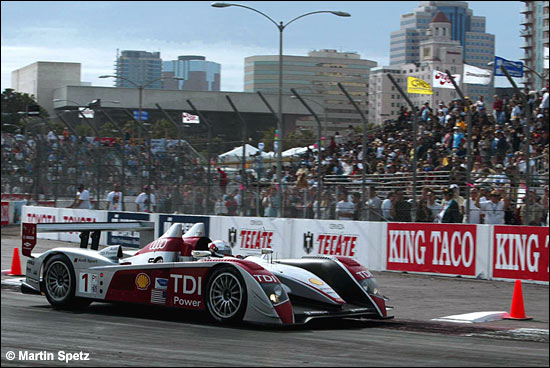

|
Was the LMS race affected in the slightest by the single Safety Car period (in the first hour, for the #51 Larbre Aston Martin, stuck on the exit of the Ascari Chicane)? Probably not – except perhaps in GT2, where a very full pit lane delayed some cars… although with the Safety Car out, a delay of an extra minute (for the Virgo Ferrari) shouldn’t have been as significant as that. It was another shambolic Le Mans Series Safety Car period. Mark Cole, throughout both broadcasts, invited viewers of Motors TV to post their comments on the Motors forum, and one viewer asked why it was that the LMS doesn’t adopt the ALMS Safety Car system – specifically, ‘Why don’t they close the pit lane until the field has formed up behind the Safety Car? David Leslie’s explanation was that different series have different rules. What he might have said is that IMSA has adopted a rigorous, tightly controlled SC procedure – and the LMS hasn’t. F2 cars used to race at Monza in the Monza Lottery years ago: here were the LMS cars racing in what seemed like their own version in 2007. But whatever went on during the Safety Car period on Sunday, it didn’t seem to materially affect positions in P1, P2 or GT1 – but seemed to in GT2. With the Motors TV commentators not on site at Monza, and the cameras not providing as much coverage of GT2 (the best race in the race) as they might have done (the same comments applying to GT2 at Long Beach).... ... there was no way that Mark Cole and friends could have followed the changes in GT2. They did follow the GT1 race for the lead – but that fizzled out with Oreca’s retirement (Doug Fehan seems to fear Oreca at least as much as Aston Martin at Le Mans).  The James Watt Porsche, Camathias at the wheel, actually led the GT2 class as racing resumed on lap 26 (it hadn’t stopped – the team’s plan was to run long on each tank-full, irrespective of Safety Cars), with the Farnbacher and Villoba Corse entries right behind: Virgo had indeed lost time, a chunk of it, crossing the line to go racing again a full 90 seconds behind the GT2 class leader. That was a gap that Rob Bell and Allan Simonsen spent the rest of the race trying to close, but that was a story that the local TV feed didn’t really follow - nor the loss of a lap by the #83 GPC Ferrari (a simple seat adjuster problem), which also spent the rest of the race trying to recover ground (to fifth). The SPEED coverage didn’t really follow the GT2 finish at Long Beach either - where Ferrari was dominant (again) too.
 |
There wasn’t a great deal of position-changing going on for the class leads at Monza, and when they did happen, the cameras didn’t always pick them up. At one point, the cameras were following a Spyker and a Corvette, while in the background, the ASM Lola was in the process of passing the RML MG-Lola for the P2 lead. Not a mention on the commentary. The cameras did catch the race’s ‘Gounon moment’ very well though, as Jean-Marc made contact with the Charouz Lola. The Mucke / Charouz entry was the star of P1 (petrol division) and the camerawork certainly did justice to this car’s performance on its debut – but with the Rollcentre Pescarolo starting from the back of the grid, Henri’s cars yet to run in full 2007 spec., and the Peugeots so dominant, LMP1 was devoid of much really good racing. It would have been a bonus to have seen Barbosa’s charge from the back, but there were the Peugeots to follow at the front at the time. 

|
LMP2’s Monza dramas mainly involved cars stuck in their garages – notably the new Zytek, the Bruichladdich Radical and the Embassy Radical – and the cameras showed all three stationary. What a shame that was, to see three of the potential winners effectively playing no part in the race. Monza needed a cracking LMP2 race, but it was still very pleasing to see the good old Horag boys come home to the win. They weren’t followed by the cameras much either though. The Peugeots certainly were, which perhaps partly explains why companies like this love to see their cars dominate an event. The slight downside is that the cameras catch any moments – such as doors coming open or Marc Gene making mistakes right at the end, even though he was cruising to the flag. Final thought after a busy weekend – three Audis against two Peugeots at Le Mans could be a real thriller, and if they all thrash their cars to the limit, perhaps the petrol P1s might be in with a shout at the end. If the diesels are reliable though, it really is going to be a five class race. Good old Motors TV will be covering the whole proceedings again.
MC |