75th Le Mans 24 Hours Preview – GT2
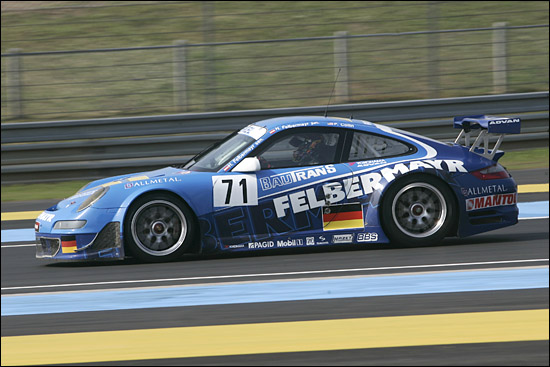
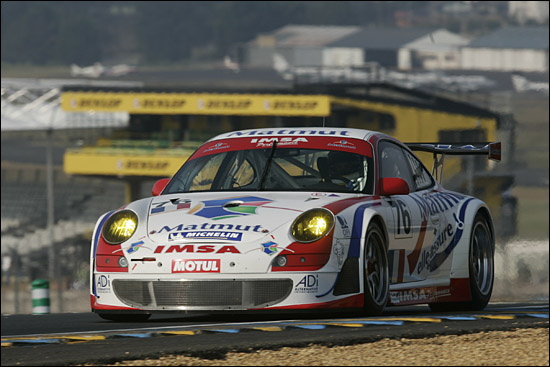
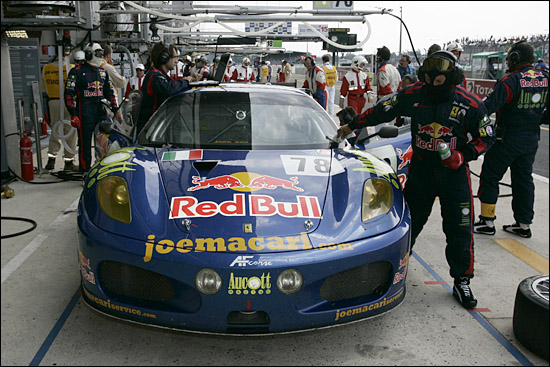
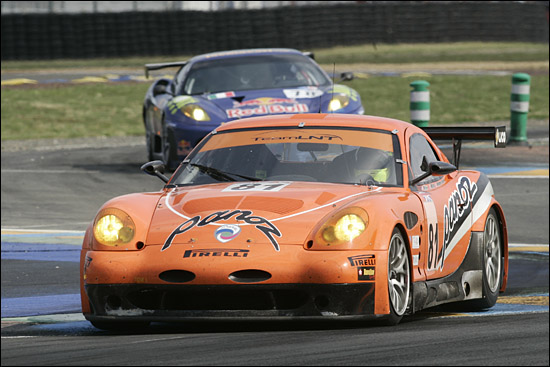
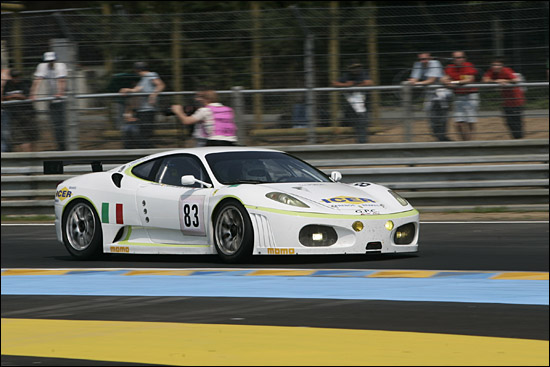
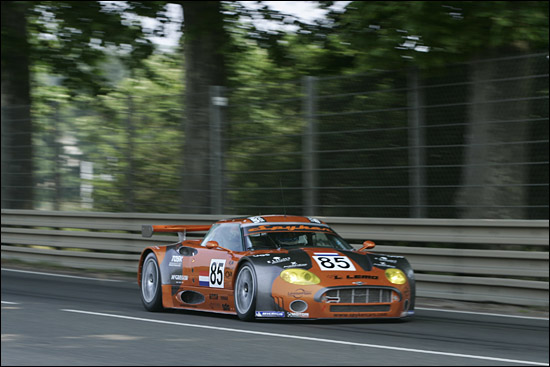
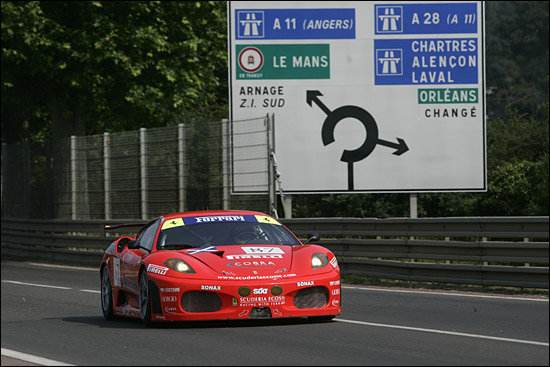
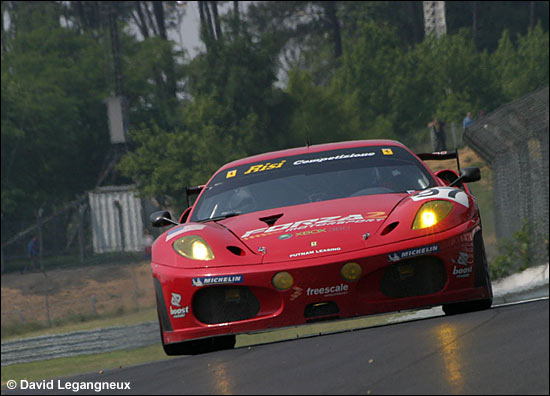
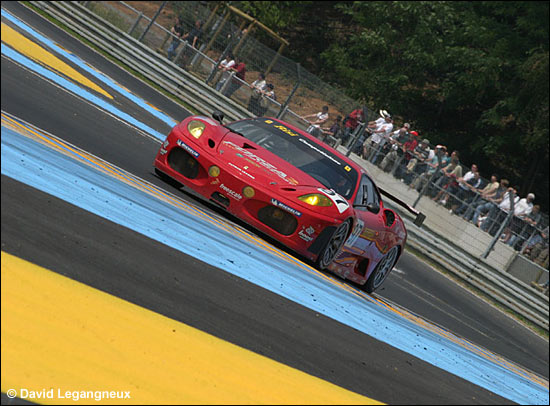
Five Star Cars For various, sometimes odd, reasons, the fancied cars in GT2 last year didn’t come good at the end of the race. GT2 at Le Mans in this millennium has sometimes seen the win go to the lone, fancied car that has hammered on trouble-free – occasionally there have been a couple of them. But last year wasn’t like that. So the question ahead of this year’s race is a simple one: will one of a select group of five entries make it through without a delay? If one of them does, hand it the laurels. If all five are delayed (or retire), then the winner could come from almost any one of the other eight. Our chosen five are the #76 MATMUT Porsche, the #80 Lizards Porsche, the #81 LNT Panoz, the #87 Scuderia Ecosse Ferrari and the #97 Risi Competizione Ferrari. So we’ve picked two Porsches, two Ferraris and a Panoz – from a class that is actually smaller than in 2006, despite the total entry being increased to 55. Scuderia Ecosse proved last year that the Ferrari 430 was ready to win – until that rear wheel became jammed on the hub. It’s very difficult to imagine that happening again. The Risi entry is at least as strong as the Scottish one: basically here are two top class Ferrari entries that could well end up 1-2 after 24 hours. Kirkaldy / Mullen / Niarchos face up to Melo / Salo / Mowlem, so there’s a slight driver advantage to the American team, and in terms of 2006 and 2007 achievements with 430s, Risi is the team – in the ALMS, and worldwide too. So Risi as favourites then – but what about the Porsches? Flying Lizards possibly did a better job than Risi at Sebring (ouch!), but lost out to the red 430 by two tenths. A Le Mans win would more than make up for the Sebring disappointment – but we don’t really know how strong the new 997 is over 24 hours. This is the model’s first Le Mans (the original two cars ran at Spa last year of course) – and the heavier, wider, more powerful, bigger-tyred (than a 996) GT2 Porsche is faster around Le Mans than the 2005-6 car. The test day times were quick, the fastest ever GT2 times at Le Mans: Pat Long’s 4:01.598 was fastest, with Allan Simonsen next in the Autorlando car (4:02.192), then Jorg Bergmeister in the Lizard example (4:02.668) – but neither of the fancied Ferraris went for a real time. But qualifying pace means very little: the result will be much more dependent on lack of problems. Team LNT has spent almost 18 months emphasizing that the team is not terribly interested in qualifying performance. The race is everything – and the longer the better. The 2006 winners came into the 2007 test day unsure of what to expect from its engines – but Elan had come up with the necessary, and Tom Kimber-Smith set the #81’s best lap, a 4:06.838, during a proper, race stint. His lap times were almost all around the 4:07.1 mark. That’s a very good race pace, isn’t it? It won’t be faster than that, will it? TK-S is joined by Tom Milner and Danny Watts. The #82 Panoz is the Lawrence Tomlinson / Richard Dean / Rob Bell car, which we’re going to call the no. 2 car, with no offence intended. Two of these three could well win the race again of course. But we’ve still got one of our top five to mention – the #76 IMSA MATMUT Porsche. This is the team that wrote off its race chassis in qualifying last year, and was given permission by the ACO to build up a replacement for the race. “In the interests of safety” was the reason, but the replacement ‘lost’ its engine. Pat Long is partnered by Richard Lietz and Raymond Narac this time. The Frenchman just gets better and better, and but for contact from an LMP2, this team would have won at Valencia last month. This is a very, very effective team, and perhaps all it lacks is Le Mans experience (Lietz). So that’s our top five, but don’t write off the other eight. The seven we haven’t mentioned begin, in number order, with the Seikel Porsche – and this, sadly, is Peter Seikel’s last Le Mans. It’s almost half (or two-thirds) of a Felbermayr-Proton Porsche, because the father and son Felbermayr pair is joined by Philip Collin. Expect a strong run from this group. The #78 AF Corse Ferrari is actually a JMB chassis (or more precisely a Joe Macari-owned 430, which JMB entered at Sebring), for Macari (a car salesman), Ben Aucott (a builder) and Adrian Newey (a car designer…). Macari set a 4:13 at the test day, the other two were in the 4:18 to 4:20 range. GPC’s Ferrari 430 was expected to have Fabrizio de Simone at the wheel, but the Spaniard Villarroel popped up at the test day in his place, with a best lap of 4:27. Carl Rosenblad set a 4:11 last week, while Matthew Marsh was happy to get his ten laps in. We’ve mentioned Simonsen’s pace in the Autorlando Porsche, and he’s partnered by the strong pair of Lars Erik Nielsen and Pierre Ehret. These two (in the Seikel Porsche) were heading for the win last year – until gearbox trouble stopped Domink Farnbacher. Don’t ignore the second Risi Ferrari, the Tracy Krohn, Nic Jonsson and Colin Braun car. Krohn was into the 4:12s at the test day, Jonsson is massively experienced, and Colin Braun is headed for stardom. And that leaves the Spykers. Andreas Belicchi and Chiesa had to complete their ten laps at the test day in the ‘Speedy’ entry: Belicchi is a former winner at Le Mans – in the Renault Spyder race in 1998. Alex Caffi is a quick man too in this entry, while Jarek Janis, Mike Hezemans and Jonny Kane lack for nothing in the #86 entry (although Janis is making his Le Mans debut this year).  Wouldn’t it be lovely to see the GT2 cars snatch a really good result, and overshadow what the F1 cars are doing? The GT2 Spyker is faster on the straights this year (by 7 kph) and we haven’t seen absolute Spyker pace at Le Mans yet this year (a best of 4:09 or so from each car last week). A Spyker could win GT2 at Le Mans – but so could most of the 13 entries. Wouldn’t it be lovely to see the GT2 cars snatch a really good result, and overshadow what the F1 cars are doing? The GT2 Spyker is faster on the straights this year (by 7 kph) and we haven’t seen absolute Spyker pace at Le Mans yet this year (a best of 4:09 or so from each car last week). A Spyker could win GT2 at Le Mans – but so could most of the 13 entries.
This could be a very good GT2 race, but in terms of the depth of entries, perhaps GT1 is the headline ‘road car’ class this year. But that doesn’t mean that GT2 won’t be a classic: it could well be. “I’m confident we’ve got a good package with a race-winning, proven car, strong engine, great tyres and consistent, solid drivers,” says Giuseppe Risi. "Having said that, we would never underestimate the magnitude of the race, and the knowledge that anything can happen at any time, and that will keep us sharp.”
MC
This is Johnny Mowlem’s lap of Le Mans, in the #97 Risi Ferrari. Just after the start finish line the road kinks right around a blind corner into the Dunlop bridge section. Although it isn’t that quick, it’s really technical as you have to brake quite heavily whilst turning into the corner. After this left/right, there is a flat out “S” section that leads you downhill into the Esses. This is easily flat, if you don’t have other cars around you, but watch out for a wicked bump just as you exit the new tarmac onto the old section, just before the Esses’ braking point. The car tends to go a little light as you go over the brow of the hill at the exit of the Esses, and you have to be careful you don’t suffer from exit power oversteer. Before you know it, you’re braking for Tertre Rouge, which takes you out onto the famous public road section of Le Mans and the Mulsanne Straight. At Tertre Rouge it is much more open now they have re-profiled the corner, which means you can get off the brakes early and carry much more speed in, as well as get earlier to full throttle to allow you to be much quicker out on to the Mulsanne straight. This re-profiling is largely responsible for the quicker lap times at Le Mans this year, and probably shows why the prototypes, with their higher downforce, are able to comparatively pick up more time as opposed to a GT car. Both the chicanes on the Mulsanne Straight are taken at a similar speed and, actually, are pretty fast for chicanes. The first goes right and left and the second the opposite way around. It’s important to have a very stable car under braking at both of these points, as well as into the Mulsanne corner at the end of the straight, as you brake very heavily at all three. Because of the undulations in these public road sections of the track, the race car can move around a lot. Mulsanne corner is a reasonably slow right-hander, and I always feel this is kind of the half way point of the lap as next you start getting into some really quick stuff! The Mulsanne corner leads out onto another straight with two flat-out blind kinks, the second of which crests slightly, which can make the steering go ever so slightly light. Then you are bearing down on the famous Indianapolis corner, which has a hugely fast open right-hander on the entry and then tightens on the exit into a tight left-hander. It is really easy to make a mistake here if you are carrying a lot of entry speed, especially if passing other cars at the same time, but the corner is certainly less daunting now the run-off area has been increased so much. Then you have a really short drag down to the tight right-hander that is Arnage, which is the slowest and, in my opinion, least enjoyable corner on the circuit. In every day life it is a 4-way crossroads and so there is always very low grip, especially at the exit, allegedly from all the oil dripping off the cars that stop at the junction! This really tight right-hander then leads out onto another straight that sweeps right, and then left, slightly up hill and you find yourself fast approaching the famous Porsche Curves. This is my favorite section of the track. You approach the first right-hander of the Porsche Curves flat out in 6th gear, and you have to move across the road from the left to the right hand side just before turn in. It’s quite bumpy as you are still on the public road at this point. In fact, you only ever really get to the middle of the road before you dab the brakes and then turn-in for the ultra fast right-hander. This is immediately followed by a flat, or nearly flat, left-hander which then leads into another “slight lift off the throttle” left-hander which immediately plunges straight into a long open 180o right-hander that is almost a constant radius corner, and incredibly quick. I always struggle to get the car dragged back to the right at the exit of this long right-hander, but it is important that you do because the final corner of the Porsche Curves is a tricky 90o off-camber left-hander where it is really easy to lose the rear at the apex. There are concrete walls beckoning you only a few feet away. Come to think of it, through the whole Porsche curves complex you are surrounded by concrete walls, with virtually no run off. You find yourself holding your breath through here! There is a short straight afterwards with a really annoying little kink in it, which is easily flat out on your own but where you can get badly held up if you are overtaking or being overtaken by another car. And then you are up to the two Ford chicanes, which are in quick succession. I brake for the first just after the pit entrance on the right, and then run a lot of speed and kerb through the first chicane as it is quite open. You then immediately have to hold the car to the right and start slowing down for the final chicane as it is a little tighter and the kerbs aren’t as flat. You also have to try and avoid the exit kerbs as these are quite aggressive here and can eat your driveshafts as soon as look at them. And that’s a lap, in a GT2 around 4 minutes, and then you go and do it all over again. For 24 hours…. hopefully!
JM |