Le Mans 24 Hours - Wrapping That One Up Part Two: LMP2 - The Finishers In the first of a two-part LMP2 “Wrap Up” piece, we consider the classified finishers in last weekend’s 80th edition of the Le Mans 24 Hours. Over the years LMP2 has earned a varied reputation, but the days when the cars were deemed “fast but fragile” have long since receded. The last two or three seasons have seen the category bolstered by (admittedly indirect) manufacturer support from both Honda and Nissan, and sufficient investment in chassis and engines to ensure that fragility is no longer an issue. When a P2 car finished fifth overall in 2010, it marked a step-change in the class, and perhaps also in the wider perception of what LMP2 represented. A field of 20 entries in this year's 24 Hours made LMP2 the largest single category in the race, and also provided some of the closest on-track competition. A dozen went the distance to be classified as finishers, with most of those who didn’t manage to last 24 hours failing as a result of accident damage. In the end, the Starworks HPD came home a comfortable winner, and we were denied the close-fought final hours that many had predicted. Despite this, LMP2 still provided some of the closest action on track, some stellar performances, and the inevitable disappointments. This review includes some fairly detailed individual race reports as well as vital statistics and data. Notes: The "Hour 0" position is starting grid. The position stated is as given "on the hour" and may not reflect a higher position achieved between the hours. The fastest top speeds shown are those set at any time during the race week, from first practice through to the race itself. Where the identical speed was achieved during the race, I have cited this instance rather than the same speed set (sometimes by another driver) in practice or qualifying. As a result, the cited driver name may not be the same as quoted in the official results sheet. The ACO has used the first instance of a given speed as listed, which may have been set during practice or qualifying, but a time set under race conditions without, perhaps, the benefit of soft compound tyres or a light fuel load, seems a better benchmark to use. The speed trap is situated along the Mulsanne, just before the first chicane. The first number given after "Pitstops" is the total number of times the car entered the pitlane (not including penalties) during the race. The second figure is the total pitstop duration in hours (where applicable), minutes and seconds. With thanks to Andy Blackmore for his excellent and totally unrivalled Spotters Guides for the header images.
1 #44 Starworks Motorsport, HPD ARX-03b Honda. Enzo Potolicchio, Ryan Dalziel, Tom Kimber-Smith Hour | 0 | 1 | 2 | 3 | 4 | 5 | 6 | 7 | 8 | 9 | 10 | 11 | 12 | 13 | 14 | 15 | 16 | 17 | 18 | 19 | 20 | 21 | 22 | 23 | 24 | Position | 9 | 5 | 2 | 3 | 4 | 3 | 2 | 4 | 3 | 3 | 1 | 1 | 1 | 1 | 1 | 1 | 1 | 1 | 1 | 1 | 1 | 1 | 1 | 1 | 1 |
| | Best laps:Ryan Dalziel: 3:41.024, Tom Kimber-Smith: 3:41.209, Enzo Potolicchio: 3:46.953 | | Best top speed: 303.5 kph; Ryan Dalziel (8th LMP2, 22nd o/all, set in race) | Qualifying: 3:40.471 | | Laps lead: 215 | Distance in race: 4824.66 km | Av.speed: 200.7 kmh | Pitstops, total time: 32, 44:27.622 |
What a stunning year 2012 is turning out to be for the Starworks squad! New to the prototype scene at the start of the season, Peter Baron’s outfit made its debut in the Sebring 12 Hours and netted a class win and an overall podium. Now, three months later, the team has claimed the even bigger prize of the LMP2 crown in the Le Mans 24 Hours. It’s fairytale stuff, and no less so for last-minute recruit to the driver line-up, Tom Kimber-Smith, who stepped in following Stephane Sarrazin’s (ultimately unrewarding) move to Toyota. It is hard to credit that just two years ago this affable and very competent Briton was muttering about a “make or break season”, and was on the verge of hanging up his helmet for good. He can now boast (though rarely does!) that he has one of the most enviable records at Le Mans of any driver – three wins from four starts, and it doesn’t get a lot better than that. Credit as well to Scot Ryan Dalziel and requisite “gentleman driver” Enzo Potolicchio, both of whom turned in excellent performances to ensure that the Starworks HPD ARX-03b ran largely untroubled from green flag to finish. It was a copybook performance, demonstrating once again that the key to winning a Le Mans title is to spend as little time as possible in the pits, keep the car on the black stuff, and don’t take unnecessary risks. The race start was taken by Tom Kimber-Smith, who made short work of moving through to seventh in P2 from a grid position of ninth. He and Warren Hughes provided rich entertainment during the opening hour of the race, swapping seventh place on a regular basis as the two vied to get ahead of Maxime Martin in the #35 Oak Racing Morgan. On the hour, Kimber-Smith moved through to fifth, taking Hughes with him, and they promptly swapped places again. It wasn’t until the second round of scheduled pitstops that both moved ahead of the Oak, and with the pink and black car out of the way (undeniably quick in a straight line, but a bottleneck through the corners) Kimber Smith was able to transfer his sights to Soheil Ayari in the Thiriet TDS Oreca. Close to the two-hour mark, Tom Kimber-Smith moved through to take second place, wholly on merit. The Starworks HPD didn’t appear to have the economy of some of the others in P2, and T K-S was among the first to stop for fuel as each sequence of pitstops came round, but the crew’s pitwork was exemplary. In support of Kimber-Smith’s inherent pace, their efforts ensured that the margin between the white #44 HPD and Olivier Pla, leading at that stage in the #24 Oak Racing Morgan, narrowed inexorably.  A quadruple opening stint (while several others swapped drivers at the third pitstop) helped to consolidate the Starworks grip on second, although this slipped after the lengthier fourth pitstop that saw Dalziel take over in the cockpit. The Scot then found himself harried by Jody Firth in the Murphy Prototypes Oreca, and dropped to fourth, but the underlying pace remained strong. Out of sequence on the driver changes, Dalziel moved back up to third when Hartley took over the #48, but the #44 dropped back again when Enzo Potolicchio took over in the sixth hour. A quadruple opening stint (while several others swapped drivers at the third pitstop) helped to consolidate the Starworks grip on second, although this slipped after the lengthier fourth pitstop that saw Dalziel take over in the cockpit. The Scot then found himself harried by Jody Firth in the Murphy Prototypes Oreca, and dropped to fourth, but the underlying pace remained strong. Out of sequence on the driver changes, Dalziel moved back up to third when Hartley took over the #48, but the #44 dropped back again when Enzo Potolicchio took over in the sixth hour.
By the time darkness descended, the Starworks HPD seemed fairly secure in third or fourth, chopping and changing with others on similar laps but different pitstop strategies. The return of Tom Kimber-Smith to driving duties just before eleven heralded an increase in pace for the #44, and just on half an hour into the new day the Starworks HPD took the class lead for the first time. By this stage Olivier Pla had hit problems in the #24 Oak Racing Morgan, and this, combined with some fast lappery from T K-S, ensured that the #44 moved steadily clear of the chasing group. Such was the extent of his advantage that the hand-over to Ryan Dalziel at quarter-to-one went by without loss of position. Running seventh overall, Dalziel maintained an impressive pace that saw the team’s lead increase to more than two minutes over the second-placed #26 Signatech Oreca Nissan. Returning Kimber-Smith to the cockpit for the next series of stints consolidated that margin. A bout of hayfever for Kimber-Smith gave Potolicchio an unscheduled stint in the middle of the night, and then Dalziel was back in the car for the dawn run. A new fastest lap came in the process; Dalziel clocking 3:41.304 as he lapped the #49 Pecom Oreca, second in P2 at six o’clock. Enzo Potolicchio returned for his next round of stints with the sun well risen, and anchored the car’s tenacious hold on the class lead. Another blistering lap (3:41.209) from Tom Kimber-Smith reinforced the car’s right as class leader, and an even quicker 3:41.024 from Ryan Dalziel in the latter stages of the races merely confirmed the strength of the team’s driver line-up.
The #44 never once relinquished the class lead throughout the second half of the race. Aside from an unscheduled pitstop for a replacement front-left tyre in the final hour, the car’s run was nearly faultless, and therein lies the secret of Le Mans success.
2 #46 Thiriet by TDS Racing, Oreca 03 Nissan. Pierre Thiriet, Mathias Beche, Christophe Tinseau Hour | 0 | 1 | 2 | 3 | 4 | 5 | 6 | 7 | 8 | 9 | 10 | 11 | 12 | 13 | 14 | 15 | 16 | 17 | 18 | 19 | 20 | 21 | 22 | 23 | 24 | Position | 4 | 2 | 6 | 16 | 14 | 13 | 12 | 12 | 11 | 10 | 7 | 4 | 4 | 4 | 4 | 4 | 4 | 3 | 2 | 2 | 2 | 2 | 2 | 2 | 2 |
| | Best laps: Mathias Beche: 3:40.728, Christophe Tinseau: 3:41.163, Pierre Thiriet: 3:43.487 | | Best top speed: 305.2 kph; Christophe Tinseau (5th LMP2, 19th o/all, set in race) | Qualifying: 3:39.252 | | Laps lead: 0 | Distance in race: 4811.03 km | Av.speed: 200.3 kmh | Pitstops, total time: 30, 46:50.698 |
Second at the chequered flag in the Le Mans 24 Hours is an achievement to be proud of in any team, but Thiriet by TDS did it the hard way, and in doing so, go some way towards proving that the podium is never lost in a 24 hour endurance race. The race kicked off well, with Matthias Beche starting from fourth, and holding it for the opening lap, despite briefly being passed by Nelson Panciatici in the #26 Signatech Nissan, before moving through to third. He then inherited second when John Martin in the pole-setting ADR-Delta Oreca dropped out of the lead. A slow second pitstop cost Beche several places, and the #46 rejoined fifth just behind Warren Hughes in the #48, but the TDS racer kept in touch with the Murphy Oreca, which was being held back by Maxime Martin in the #35 Oak. For half an hour or so the trio ran nose-to-tail, and provided rich entertainment for the TV producer, who followed the battle for several laps. The tussle was split when the race leaders came through to lap the LMP2 front-runners for the first time, with Beche suffering from the intrusion and dropping off the back of the skirmish. However, as one of the last cars in the leading group to pit, Beche had moved through to third by the time the race was into its third hour, but that all went to pot at the next pitstop, when the #46 was delayed for more than eight minutes.  Pierre Thiriet took over during the extended pitstop, and returned to the track in 16th place. He then completed a steady and fairly uneventful triple-stint that restored the car to 13th in class. Christophe Tinseau climbed aboard soon after nine, and a 3:41.163 was the quickest yet for the #46. It took the Thiriet by TDS Oreca through to 20th overall, 12th in LMP2. Pierre Thiriet took over during the extended pitstop, and returned to the track in 16th place. He then completed a steady and fairly uneventful triple-stint that restored the car to 13th in class. Christophe Tinseau climbed aboard soon after nine, and a 3:41.163 was the quickest yet for the #46. It took the Thiriet by TDS Oreca through to 20th overall, 12th in LMP2.
By the time Beche returned to the car late on Saturday, the progress had been encouraging, and the #46 was rounding off the top-ten in P2. Matthias proved that setting quick times in the dark at Le Mans is always a possibility by posting a 3:40.991, and he maintained a rapid pace for nearly two hours, combining that determination with the misfortunes of others to gain several more places. By half-two the #46 was lying a fairly healthy fourth in P2, and looking strong. From then on to the flag, it was just a case of keeping out of trouble, setting a brisk pace, and steadily picking up places. All three drivers took it in fairly even turns, with Pierre Thiriet, in particular, exceeding expectations. His duel with Pierre Ragues for third place was especially intense, but he eventually took the position on the run down into the first Mulsanne Chicane, although Ragues then attempted to return the compliment and the two remained close for a couple more laps. A short while later, Thiriet was the beneficiary when Soheil Ayari beached the #49 Pecom Racing Oreca at Indianapolis, and the #46 moved through to second in P2. Aside from the inevitable place-swapping in the pitstops, that was largely the way the rest of the race panned out for the Thiriet by TDS Oreca. Beche put in some hot laps around lunchtime on Sunday, and helped to cement the team’s hold on second, although a late challenge from Pierre Kaffer narrowed the gap. There was a sharp intake of breath in the TDS garage with less than an hour to go when Beche, charging to the flag, ran wide and took to the gravel, but he regained the track without losing too much time. A late pitstop to replace the left rear tyre saw Beche to the chequered flag and a well-deserved second place. An excellent result for the squad in their first run at Le Mans.
3 #49 Pecom Racing, Oreca 03 Nissan. Luis Perez-Companc, Pierre Kaffer, Soheil Ayari Hour | 0 | 1 | 2 | 3 | 4 | 5 | 6 | 7 | 8 | 9 | 10 | 11 | 12 | 13 | 14 | 15 | 16 | 17 | 18 | 19 | 20 | 21 | 22 | 23 | 24 | Position | 5 | 3 | 3 | 6 | 6 | 6 | 6 | 7 | 4 | 5 | 2 | 3 | 2 | 2 | 2 | 2 | 2 | 2 | 2 | 3 | 3 | 3 | 3 | 3 | 3 |
| | Best laps: Soheil Ayari: 3:39.641, Pierre Kaffer: 3:40.770, Luis Perez-Companc: 3:44.207 | | Best top speed:302.7 kph; Luis Perez-Companc (11th LMP2, 25th o/all, set in QP1) | Qualifying: 3:39.711 | | Laps lead: 0 | Distance in race: 4797.40 km | Av.speed:199.7 kmh | Pitstops, total time:33, 46:03.015 |
Picking up the final podium step was the Pecom Racing Oreca 03 Nissan, shared by the hugely experienced ex-Audi pilot Pierre Kaffer, Soheil Ayari (with extensive Oreca knowledge) and Argentinian ice cream mogul and team owner Luis Perez-Companc. Any podium at Le Mans is an achievement, but this one could so easily have been a step higher, had it not been for a chance misfortune late in the race. Frenchman Soheil Ayari took the start, and made an impressive fist of it, slicing through to fourth by passing Nelson Panciatici in the #26 Signatech Oreca on the second lap, and then picking off two more slots before the half hour to be running second, narrowly ahead of Tom Kimber-Smith. The Starworks HPD driver duly took the place, but Ayari was strong in third before the team decided to change drivers at the second pitstop. Being virtually the only team in P2 to do so cost the team dearly, and Pierre Kaffer returned to the track in fifth. The situation was made worse when he had to return to the pits again within ten minutes (to replace a punctured tyre, we think), and dropped to sixth. Kaffer pushed hard to regain some of the deficit, and a quadruple stint helped the #49 back to fifth before the hand-over to Perez-Companc. The pitstop was again out of sequence with most others, and the extra time for the driver change knocked the #49 down a place, and then the same happened again when Soheil Ayari reclaimed the driver’s seat for the ninth stint.  That was the low point for the team. A succession of new fastest laps for the #49 from Ayari helped to stem the tide, and a 3:41.743 was enough to ease the car through to 6th in class, 12th overall. More rapid laps followed, and over the next couple of hours Ayari moved inexorably up through the order, peaking at fourth before the hand-back to Kaffer. That was the low point for the team. A succession of new fastest laps for the #49 from Ayari helped to stem the tide, and a 3:41.743 was enough to ease the car through to 6th in class, 12th overall. More rapid laps followed, and over the next couple of hours Ayari moved inexorably up through the order, peaking at fourth before the hand-back to Kaffer.
Pierre rejoined just behind Ragues in the #26, but despite there being less than a second between them, it took Kaffer an hour or more to find the gap he needed. At dot on one in the morning, he finally made the move, and the #49 was through into second. Having gained the place, the challenge now was to hold on to it. A triple stint from Kaffer was followed by a double from Perez-Companc, during which the Argentinian biefly lost the slot to Pierre Ragues in the #26 Signatech. The gap between the two was never huge, and when Ayari picked up the baton at the start of his next triple, Rusinov was in the #26. Some impressive laps from Ayari, including a 3:40.943 (easily the fastest in class at the time) served to shake off the challenge, and reaffirm the hold on second. All looked set fair until around nine-fifteen, when Ayari ran wide at Indianapolis and buried the #49 Pecom Racing Oreca deep in the gravel. Pierre Thiriet was first to sweep by in the #46, followed moments later by the #26, although the latter promptly pitted. Ayari had to head for the pits himself after his gravelly excursion, but was swiftly sent back out again to complete a quadruple stint. Pierre Kaffer returned to the Pecom Oreca for the next stint, and was gaining on Matthias Beche in the #46 for second, but the gap was too much to close. Briefly taking the place when the TDS Oreca pitted was illusionary, and the team would have to settle for third at the flag.
4 #26 Signatech Nissan, Oreca 03 Nissan. Pierre Ragues, Nelson Panciatici, Roman Rusinov Hour | 0 | 1 | 2 | 3 | 4 | 5 | 6 | 7 | 8 | 9 | 10 | 11 | 12 | 13 | 14 | 15 | 16 | 17 | 18 | 19 | 20 | 21 | 22 | 23 | 24 | Position | 3 | 11 | 11 | 7 | 8 | 5 | 5 | 5 | 5 | 4 | 3 | 2 | 3 | 3 | 3 | 3 | 3 | 3 | 4 | 4 | 4 | 4 | 4 | 4 | 4 |
| | Best laps: Nelson Panciatici: 3:41.860, Roman Rusinov: 3:42.911, Pierre Ragues: 3:43.738 | | Best top speed: 301.1 kph; Nelson Panciatici (13th LMP2, 27th o/all. Set in QP1) | Qualifying: 3:39.152 | | Laps lead: 0 | Distance in race: 4783.77 km | Av.speed:198.7 kmh | Pitstops, total time: 31, 45:46.681 |
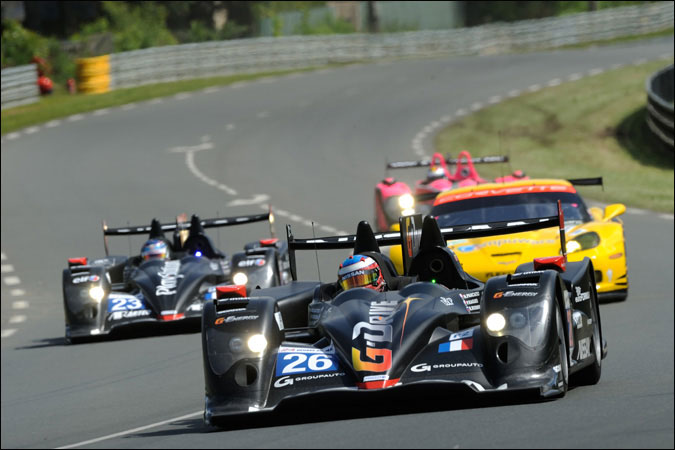
It was a consistent if rarely inspiring run from the #26 Signatech squad that rewarded the team with fourth place in last weekend’s 24 Hours. Lacking any megastar drivers, the trio of Nelson Panciatici, Pierre Ragues and Roman Rusinov relied on a steady pace, minimal errors and a modest 45 minutes in the pits to secure a result they should be proud of. Having set the third quickest P2 time in qualifying, Panciatici took the race start, and lost out to Matthias Beche in the #46 Thiriet TDS Oreca on the run through to Dunlop, ending the opening lap in fourth. Next time around it was Soheil Ayari who came by in the Pecom Racing Oreca, the #49, followed by Tom Kimber-Smith and then, minutes later, by Warren Hughes in the Murphy Oreca #48. In the space of six or seven laps, Panciatici had dropped four places.  The situation was made to look even worse when the team made a driver change at the first pitstop, replacing Panciatici with Pierre Ragues, and allowing nearly half the P2 field to stream by. Ragues rejoined in 12th, but that was as bad as it got. From then on, for the next 23 hours, the #26 ran like a Swiss watch, steadily making up ground and regaining places. The situation was made to look even worse when the team made a driver change at the first pitstop, replacing Panciatici with Pierre Ragues, and allowing nearly half the P2 field to stream by. Ragues rejoined in 12th, but that was as bad as it got. From then on, for the next 23 hours, the #26 ran like a Swiss watch, steadily making up ground and regaining places.
By the four-hour mark Roman Rusinov had the #26 up to 8th. A couple of hours later and Panciatici was rejoining in 7th, 13th overall, before completing his stint in fifth. By midnight Pierre Ragues had the #26 circulating in fourth, and from then, to third. It was all fairly routine stuff, and simply by keeping out of trouble and maintaining a steady pace, the team was making up ground. During the early hours of Sunday morning this strategy was paying healthy dividends, and Rusinov was within 8 seconds of Ayari for second place. However, with the #49 Pecom, #46 TDS and the #26 all on the same lap, it only took a pitstop to alter the order. For the best part of six hours the battle for second surged back and forth between the three. It wasn’t until 10:45 that the resolution came, in the form of a puncture for Rusinov. He was on his first or second lap after a scheduled pitstop when the right-rear tyre deflated and was ripped from the rim as he sped through Indianapolis. The car slewed side-on across the track and was only narrowly missed by several passing cars. Rusinov completed a slow return to the pitlane to hand over to Nelson Panciatici, but the car was hauled back into the garage for remedial work and lost a further six minutes. The delay cost the team a couple of laps but Panciatici still managed to resume 4th in P2. He promptly set a string of new best laps for the #26 Signatech Oreca, but it wasn’t enough. Ragues completed the final stints to bring the car across the line a lap short of a podium, but with honour intact.
5 #41 Greaves Motorsport, Zytek Z11SN Nissan. Christian Zugel, Elton Julian, Ricardo Gonzalez Hour | 0 | 1 | 2 | 3 | 4 | 5 | 6 | 7 | 8 | 9 | |  |
|
|