Catching Up With.... Doug Fehan
On GT Regs Gary Horrocks caught up with Corvette Racing's Doug Fehan on Thursday at Sebring, and asked him about the new-for-2012 GT regulations. Thus far, the Corvette Racing team has been very strong in the GT(E) category here at Sebring. A 1-3 in the morning session and an early 1-2 in the afternoon session on Thursday shows that the team is on the right track towards recovery from what was a somewhat disappointing 2011 season. Debuting here is the new wide track Corvette, which is much more than a simple 2” widening of the existing car.  Doug Fehan filled in the details before the session started. “It isn’t a totally new design. It’s probably best viewed as an evolutionary design, rather than a revolutionary design. At the front, we widened the track by lengthening the control arms. Because the rules don’t allow you to section the fenders, we added to the flares, which give it sort of an old school look that I like. It really fits the car. At the rear, we widened the track by changing the offset of the rims. The existing rear suspension is intact, as we raced it last season.” Doug Fehan filled in the details before the session started. “It isn’t a totally new design. It’s probably best viewed as an evolutionary design, rather than a revolutionary design. At the front, we widened the track by lengthening the control arms. Because the rules don’t allow you to section the fenders, we added to the flares, which give it sort of an old school look that I like. It really fits the car. At the rear, we widened the track by changing the offset of the rims. The existing rear suspension is intact, as we raced it last season.”
All of this wide body stuff happened because the Ferrari 458 was homologated to a wider width than had been previously mandated in the regulations. Because that was allowed, the other GT manufacturers were also allowed to run to a wider width if they wanted. The class regulations are discussed in a GT entrants group, and group works together to insure that the regulations work for all involved. In this case the group also realized that the Corvette was lacking in proper aero when it came to the rear wing. “The group saw that the Corvette has a unique rear deck, and the way the car was last season did not allow the rear wing to work properly. It was too low, so they allowed us to raise the wing 75mm to put it into cleaner air. That increased the rear downforce, so we had to balance the car by adding some downforce at the front. We did that by adding dive plane whiskers at the front.” The aero package was further addressed by new side mirrors, which offer a reduction in drag. According to Doug, the Corvette last season had go-kart handling traits. It would slide around quite a bit, which may have been fun for the drivers, but it wasn’t good on the Michelin rubber. “We had a good car for qualifying and even the first part of a stint, but the more the car moved around, the faster the tires went away. Now the car is solid and the tires last. The drivers really picked up on the change.” 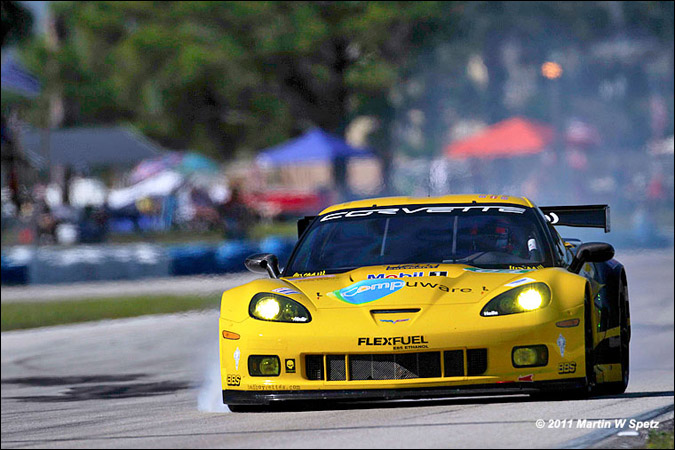

2011 v 2012
|
While some of these changes appear that they would improve the performance of the car, the majority of them improve the car by making it more manageable or consistent. An example is in the motors. Doug stated, “The engine guys at GM Powertrain have done a magnificent job. It’s not easy to take a block designed for 7 liters and make it work right at 5.5. But they have and they continue to make improvements. The latest improvement is a new intake. It doesn’t create more power, but it gives the engine better driveability.” All of this is part of the plan. Doug built this program to have a direct link to the street Corvettes. “We strive to keep the technology transfer going between the race car and the street car. It is important to us, in fact it is the basis for the program.” The technology connection between the race and street cars is what has kept the Corvette program going in what has been a pretty hostile environment for car manufacturers. Because the Corvette has been around for quite some time now, it is pretty well developed. Even if the team wanted to make wholesale performance changes, they really can’t. They’re limited to incremental changes - small changes that add small performance gains, but when they’re all added together, the changes can become significant. But the team has to be careful about the changes they make. Too much of a performance change will be greeted with a restrictor or weight penalty by the rules makers. The GT regulations are sometimes difficult to understand. The ACO states that they want to contain costs, but then they allow these sorts of changes, which add to the cost of racing. But some of the changes make can make sense, according to Doug; “The paddle shifter is a prime example. It is a costly piece to purchase and to incorporate into the car. It is not ‘off the shelf and bolt it in’ at all. It must be carefully integrated into the car in order to work properly. On a lap, it may save a few tenths, but that is not the real benefit. The savings come in with reduced wear and tear on the gearbox. Can we quantify the cost savings, or are there even cost savings by going that way? That I couldn’t tell you. But that is a way of justifying the changes.” As the years move on, technology changes happen, but there are some that view what GT(E) has and is becoming as going too far; that they are encroaching on what used to GT1 levels. Does Doug see it that way? “I remember when we broke the 2:00 barrier here (2002 – Ron Fellows). That was quite an accomplishment. Here we are, but now we’re running 100 or so HP less and we’re ready to break through that again. To do so with that much less power is really something. It shows how complex these cars have become.” While Doug agrees that maybe things have gone too far, he is much more comfortable with the way things are than what he sees with the GT3 class. He is not a fan of that class, seeing it completely out of control. (An interesting aside here is that the current Corvette is now wider than the old GT1 spec Corvettes, which at that time were considered very wide cars.) Some have seen the WEC as a detriment to the health of the ALMS. Has the WEC been an attraction to Doug and has he considered running in it? “We have good partners running in Europe. Why would we want to compete against them? We race here in the ALMS and are proud to do so. It fits our program parameters. That isn’t to say that we don’t look at alternatives. We do.” As long as the team has the option of racing at Le Mans, that seems to address their European interests, at least for the time being. Here in the ALMS, the team has made an effective use of the car corrals and has established a strong rapport with their fans – maybe stronger than any other make in the series. Witness the autograph sessions – it is the Corvette team that consistently has the longest of the lines of fans waiting patiently to meet their heroes. The 2012 season kicks off for real this weekend and we’ll be able to see first hand how the development of the Corvette has progressed. Gary Horrocks | 


