Le Mans 24 Hours - Wrapping That One Up
Part Four: LMP2, Retired Hurt In the conclusion of our “Wrap Up” piece on LMP2, we take a look at the fortunes – and misfortunes – of those eight cars that didn’t manage to go the distance in the 80th edition of the Le Mans 24 Hours. Of the twenty starters in the class, twelve were classified at the finish, but eight fell by the wayside. Among those are several big-name players; teams who had been expected to do well, and one in particular which clearly demonstrated the potential that many had anticipated. At the other end of the scale, sadly, are one or two whose demise was equally predictable, and for whom Le Mans 2012 will not be remembered as a pinnacle of achievement. As with Part One, please note that fastest speeds stated are those set at any time during the race week, from first practice through to the race itself. Where the identical speed was achieved during the race, I have cited this instance rather than the same speed set (sometimes by another driver) in practice or qualifying. As a result, the cited driver name may not be the same as quoted in the official results sheet. (The ACO has favoured the first instance a given speed was achieved, which may have been set during practice or qualifying. My feeling is that a time set under race conditions without, perhaps, the benefit of soft compound tyres or a light fuel load, seems a better benchmark to use. The speed trap is situated along the Mulsanne, just before the first chicane. The first number given after "Pitstops" is the total number of times the car entered the pitlane (not including penalties) during the race. The second figure is the total pitstop duration in hours (where applicable), minutes and seconds. Positional boxes tinted yellow are post-retirement. With thanks again to Andy Blackmore for his excellent and totally peerless Spotters Guides for the header images. 13 #38 Jota, Zytek Z11SN Nissan. Sam Hancock, Simon Dolan, Haruki Kurosawa Hour | 0 | 1 | 2 | 3 | 4 | 5 | 6 | 7 | 8 | 9 | 10 | 11 | 12 | 13 | 14 | 15 | 16 | 17 | 18 | 19 | 20 | 21 | 22 | 23 | 24 | Position | 12 | 16 | 14 | 12 | 9 | 10 | 10 | 9 | 6 | 7 | 5 | 6 | 10 | 12 | 12 | 12 | 13 | 12 | 10 | 10 | 10 | 13 | 13 | 13 | 13 |
| | Best laps: Sam Hancock: 3:41.683, Simon Dolan: 3:43.174, Haruki Kurosawa: 3:46.319 | | Best top speed:301.0 kph; Haruki Kurosawa (15th LMP2, 29th o/all, set in race) | Qualifying: 3:41.287 | | Laps lead: 0 | Distance in race: 3693.45 km | Av.speed: 187.2 kmh | Pitstops, total time: 24, 1:29:30.176 |
Jota has a very lengthy association with the Zytek factory, and has been campaigning the same basic chassis, on and off, for nearly nine seasons. Sam Hignett’s outfit took delivery of their first Zytek in 2004, and competed in the LMES (as it was then) as well as the ALMS, the Le Mans Series and, of course, in the 24 Hours. Some of those appearances were in LMP1, a few involved the Zytek-developed hybrid engine, and more often than not Jota was, in effect, the factory team. So for six out of the past nine seasons, Jota has raced with Zytek, and the team arrived at La Sarthe with a strong driver line-up and a car that Greaves had proven in 2011 was well capable of taking the crown. “We know that the Zytek is good around here,” said Hignett before the race, “and the nice thing is, you press the button, and it all works!” 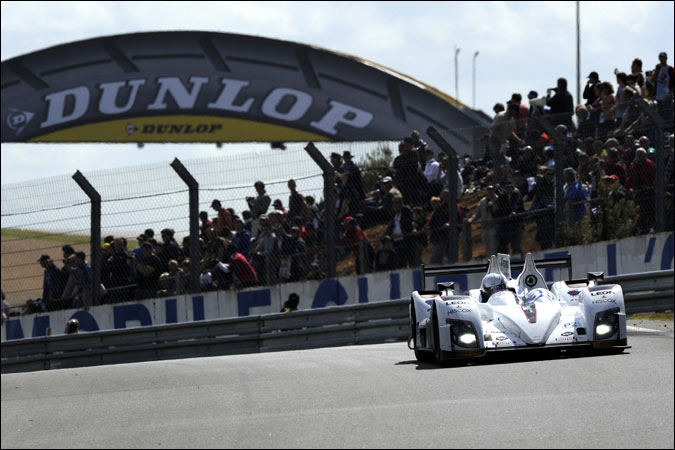 |
Also favouring Jota was chief engineer on the #38 for the 24 Hours Tim Holloway, who had worked on the original design of the car. His experience enabled the team to establish a fairly good set-up early on in practice, but not everything went brilliantly. A couple of minor offs and some accident damage curtailed running, but 12th on the grid wasn’t an insurmountable challenge. With the brisk (and elegant) Sam Hancock supported by the capable Haruki Kurosawa, and with Simon Dolan proving himself no mean pedaller either, the prospects were good.  The first few hours were fairly uneventful. Sam Hancock took the start, and lost a couple of places on the opening lap (to Christophe Bouchut (#33) and Franck Mailleux in the #23) and then a handful more on the sixth lap after a minor indiscretion before starting a steady climb up through the P2 field. By the time Simon Dolan took over the #38 was running 9th in class, and the rise through the ranks continued. Kurosawa maintaining the momentum, and come midnight (and the middle of Sam Hancock’s quadruple stint) Jota was challenging for fifth.
That was as high as the #38 reached. Sam Hancock returned to the track in 7th and enjoyed some breathing space over Yelmer Buurman, 8th in the #30 Status GP Lola, which allowed him to move forwards again. Simon Dolan took over for the next quadruple run, but contact “with something very solid” resulted in a ten-minute pitstop for repairs (at around 02:20) and was followed by a strange incident at 03:42 when Simon appeared to lose electrical power coming through Dunlop. His lights went out, he spun, and the Zytek ended up facing the wrong way after making light contact with the barriers. The #38 was pulled free and Dolan returned to the pits, headlights ablaze once more. The stop this time, to sort out what were evidently fairly serious electrical problems, lasted over 20 minutes. Kurosawa took over, but the car had dropped to 13th in class. There were more stops to follow, and then a brief off-track excursion for Sam Hancock at Arnage as the sun was rising. In the main, though, the direction was positive again, and the Jota Zytek recovered to 10th. At just after half-ten, with four and a half hours remaining, Simon Dolan was coming through the Porsche Curves when the car snapped away from him. The rear made heavy contact with the unforgiving concrete wall, and spun back across the track. Initially the engine wouldn’t re-start, but Dolan coaxed it back into life, and then began a painful journey back to the pitlane. From the view on the monitors it was clear that the car had sustained extensive damage, and Dolan was finding it very hard to maintain direction. With smoke billowing from the tyres, chafing on the rearranged bodywork, he did well to get the car back to the garage at all, but it was soon clear that the car was fairly comprehensively wrecked. At 11:18 the #38 was confirmed as the eighth LMP2 retirement. 14 #33 Level 5 Motorsports, HPD ARX-03b Honda. Scott Tucker, Christophe Bouchut, Luis Diaz Hour | 0 | 1 | 2 | 3 | 4 | 5 | 6 | 7 | 8 | 9 | 10 | 11 | 12 | 13 | 14 | 15 | 16 | 17 | 18 | 19 | 20 | 21 | 22 | 23 | 24 | Position | 14 | 7 | 8 | 13 | 13 | 12 | 13 | 13 | 10 | 11 | 9 | 9 | 7 | 7 | 6 | 6 | 6 | 8 | 15 | 14 | 14 | 14 | 14 | 14 | 14 |
| | Best laps: Christophe Bouchut: 3:42.230, Luis Diaz: 3:42.796, Scott Tucker: 3:47.979 | | Best top speed: 303.5 kph; Luis Diaz (7th P2/21 o/all, set in race)| Qualifying: 3:42.224 | | Laps lead: 0 | Distance in race:3270.96 km | Av.speed:196.0 kmh | Pitstops, total time: 22, 33:19.859 |
Following a class win in the Sebring 12 Hours in March, another win at Long Beach in April, and then a third victory (second overall) at the Mazda Raceway, Laguna Seca in May, and Level 5 were aiming high when the team arrived at Le Mans for the 24 Hours. Over the last two or three seasons, the team has tried a broad spectrum of engine and chassis combinations, but having gone down the HPD route for 2012 Scott Tucker’s outfit looked as well-prepared and eager as circumstances would permit, and provided everything went smoothly, a good result seemed more than likely. In the ALMS, Scott Tucker has found a variety of co-drivers to share duties in the cockpit, including Franck Montagny and Joao Barbosa, but the line-up for Le Mans included two other regulars; Luis Diaz and Frenchman Christophe Bouchut. Mexican Luis Diaz, nicknamed Chapulín (the ‘Cricket’), is in his second season with the team, but has a long history of campaigning the HPD chassis, having moved to the ALMS from Grand-Am to join Fernández Racing in 2007. A former winner with Peugeot, and making his 19th appearance at Le Mans (his third alongside Scott Tucker) Christophe Bouchut has undoubted experience of the La Sarthe circuit,and finished on the LMP2 podium last year with Level 5.  |
So the chances, on paper anyway, looked excellent, but practice and qualifying suggested that not everything was rosy in the Level 5 garage. A few gravelly incidents and damage to the gearbox on Wednesday, and then missing the second session completely left reduced opportunities for optimising the set up the HPD, and less chance of a good qualifying time as well. 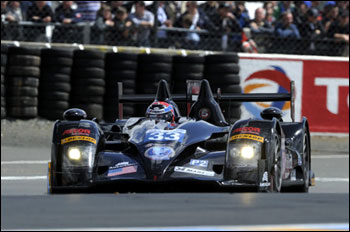 Fourteenth on the grid probably came as a disappointment, and left race-starter Christophe Bouchut with a lot to do. He soon discovered as well that the HPD wasn’t giving him the pace he’d expected, and while he took the first hour fairly carefully (it is all relative, of course) a chance brush with a GT car and then contact with the barriers about an hour in didn’t help. He subsequently suggested that the aero may have been upset as a result, but even so, he moved through to 7th in class, 17th overall, inside the first hour.
A couple of delayed pitstops – only by a minute or so, but it all adds up – stemmed the assault somewhat, and after an initial drop to 13th, the Level 5 HPD was running 11th in class by the time Saturday ticked over into Sunday. At half-two Bouchut handed over to Luis Diaz, and the Mexican ran strongly throughout a quadruple stint that saw him in a tight battle for 8th with Tor Graves in the #25 ADR-Delta Oreca.It was a duel that the Level 5 driver eventually won,and helped to set up Bouchut for the next contest with Ricardo Gonzalez in the Greaves #41. That came to a head at the restart after the safety car period for the Prospeed Porsche incident, but the Zytek had the edge on pace, and Bouchut had to be content with 6th. And there lay the rub. The #33 simply didn’t have the pace that perhaps it should have, and despite some steady work from all three drivers, the lap times weren’t competitive. Around seven o’clock, with Scott Tucker in the car, 6th place was relinquished to John Martin in the #25 ADR-Delta, and then forty minutes later, Scott’s run came to a free-wheeling end on the run out of Arnage. The #33 had left the pits, having taken on fuel, at 06:55. At 07:47 it coasted to a halt. The official line was “low fuel pressure”, but a combination of a malfunctioning radio link, and Scott’s view of the pit signalling board being obscured by the rising sun, suggests that “no fuel” might have been more accurate. The crew on the wall had tried everything possible to catch Scott’s attention as he sped past, including waving the Stars & Stripes, but without success. A doubly frustrating way to end a race, especially after seventeen hours. 15 #30 Status Grand Prix, Lola Judd. Alexander Sims,. Yelmer Buurman, Romain Ianetta Hour | 0 | 1 | 2 | 3 | 4 | 5 | 6 | 7 | 8 | 9 | 10 | 11 | 12 | 13 | 14 | 15 | 16 | 17 | 18 | 19 | 20 | 21 | 22 | 23 | 24 | Position | 8 | 19 | 13 | 11 | 10 | 9 | 11 | 10 | 8 | 8 | 8 | 7 | 14 | 14 | 14 | 13 | 12 | 13 | 12 | 15 | 15 | 15 | 15 | 15 | 15 |
| | Best laps: Yelmer Buurman: 3:41.976, Alexander Sims: 3:43.113, Romain Ianetta: 3:52.237 | | Best top speed: 298.5 kph; Yelmer Buurman (17th LMP2, 32nd o/all, set in QP3)| Qualifying: 3:40.280 | | Laps lead: 0 | Distance in race: 3257.33 km | Av.speed:183.9 kmh | Pitstops, total time: 24, 1:24:39.942 |
Following on from Alex Sims’ fairly horrific crash at Spa, Status GP were hoping for a repeat of their much more rewarding run to the podium at Paul Ricard when they arrived at Le Mans. The former winner of the McLaren Autosport Young Driver Award (2008) would be eager to put his Belgian experience behind him, while those with an eye on new faces would be keen to see if Yelmer Buurman could maintain his impressive first season in prototypes. They were joined by French driver Romain Ianetta, making his fifth appearance at Le Mans, but perhaps best known for his stunt driving sequence in The Bourne Identity – a skill he’d hopefully not require at Le Mans. The race didn’t get off to a great start. Buurman was back into the pits with less than a quarter of an hour completed. We never did find out what the stop was for, but it wasn’t lengthy, so may have only been for a replacement tyre, but so early in the race, the impact on race order was catastrophic. Buurman rejoined 50th overall.  That glitch dispensed with, the next five hours went well, and the pace of the P2 car allowed Buurman, and then Sims, to slice through the GT cars and tag on at the end of the P2 group. From there, the inherent pace of both drivers carried the Lola on through the field, peaking at around half-two on Sunday morning when the #30 moved through to take 6th in class. Minutes later Jody Firth, recovering in the Murphy Prototypes Oreca #48, snatched the place back, but it wasn’t clear at the time whether this was before, or after, the Status GP Lola sustained a puncture. Either way, Sims was soon limping back towards the pitlane, where he was rebooted and sent back on his way, 10th in class. He was back again ten minutes later having made heavy contact with a barrier, the front bodywork of the Lola totally missing as he returned the car to the garage. It took the team half an hour to make good the damage, and Sims was allowed out again, rejoining 13th in LMP2.
The next pitstop at 04:30 was on schedule, but was very nearly anything but routine. Sims was heading for pits just as Brendon Hartley in the #48 Murphy Oreca was struggling to cope with collapsing rear suspension at the pit entry. The two cars narrowly missed one another, and Sims would enter unscathed – Hartley’s race was coming to an untimely end. Romain Inaetta completed an uneventful double stint before handing back to Dutchman Buurman for the run through sunrise, and all looked to be back on track. ‘Under the hood’, however, all was not well with the electrics on the Lola’s Judd engine, and alternator failure was diagnosed during a lengthy 20-minute pitstop. Regrettably, the failure had done invisible but terminal damage to the battery, and at 08:47 Yelmer Buurman drew up trackside, initially at one of the Mulsanne chicanes, but ultimately at Mulsanne Corner. The ironic thing was, Buurman was on his in-lap at the time, preparing to hand over to Alex Sims. Had he been able to complete that final half-lap, all might have been recoverable. Instead, the #30 became the 6th P2 retirement. 16 #48 Murphy Prototypes, Oreca 03 Nissan. Jody Firth, Brendon Hartley, Warren Hughes Hour | 0 | 1 | 2 | 3 | 4 | 5 | 6 | 7 | 8 | 9 | 10 | 11 | 12 | 13 | 14 | 15 | 16 | 17 | 18 | 19 | 20 | 21 | 22 | 23 | 24 | Position | 6 | 6 | 5 | 4 | 3 | 4 | 3 | 1 | 1 | 1 | 6 | 8 | 6 | 6 | 11 | 16 | 16 | 16 | 16 | 16 | 16 | 16 | 16 | 16 | 16 |
| | Best laps: Brendon Hartley: 3:40.770, Warren Hughes: 3:41.585, Jody Firth: 3:43.068 | | Best top speed: 320.4 kph; Jody Firth (1st LMP2, 9th o/all, set in race) | Qualifying: 3:39.877 | | Laps lead: 27 | Distance in race: 2671.28 km | Av.speed:199.1 kmh | Pitstops, total time: 17, 29:38.154 |
Much as Warren Hughes wanted Murphy Prototypes to stay “below the radar” in the run-up to the 24 Hours, it was hard to hide from the reality that the team was one of the LMP2 pre-race favourites this year. The combination of pace and experience that the team’s three drivers encapsulated made the line-up look particularly strong, and with the Oreca Nissan chassis in good hands (in the form of the former RLR-Msport crew headed by Nick Reynolds) there was plenty of wise money on the Irish entry. A strategy that majored on race preparation and denied Hughes the chance of a stab at any very quick times in qualifying may have been deceptive – perhaps deliberately so – and the #48 lined up a relatively modest 6th on the grid. We’ll be looking at the Murphy Prototypes race in more detail in a full race report, but it was a consummate display of endurance racecraft. The pace was excellent, but the drivers took no risks, and the emphasis was always on the end-game. 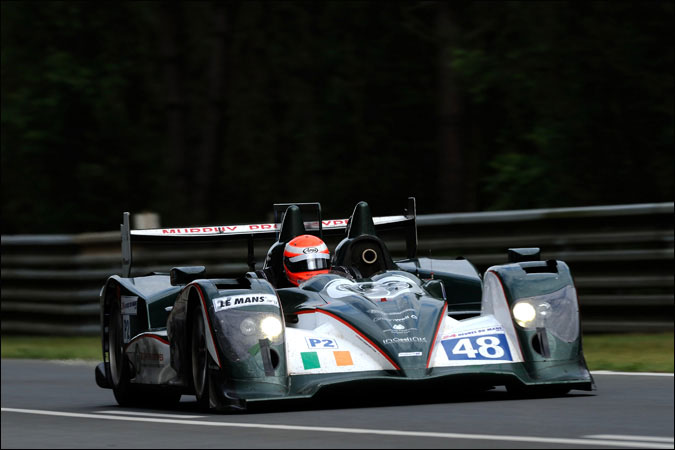 |
Having taken the opening lap relatively calmly, staying out of trouble and conceding a place to Maxime Martin in the #35 Oak, Warren Hughes settled down to the task with aplomb. He might later wish he’d not given up that position so readily, as getting back past Martin proved to be a monumental challenge, and one that kept him busy for the best part of two hours. Indeed, the Geordie was mightily sick of the sight of the pink and black rump of that Oak Morgan by the time he handed over the reins to Jody Firth for the second set of stints. In between while, though, he and Tom Kimber-Smith in the Starworks HPD had provided some of the best on-track entertainment of any pairing in the race, passing and re-passing one another six or seven times in as many laps. It was a delight to watch such commensurate skill, and to know that the two would maintain their respective challenges cleanly and without rancour or contact until one or other finally made the move that counted. In the end it was the pitlane that divided them, and then the driver change. Firth picked up the baton where Hughes had left it, and continued to make up the ground. Three hours into the race and the steady progress had been rewarded with fourth place, and more than a minute separated Firth from Alex Brundle in the #42, fifth. Once again, the target in sight was the #44 Starworks HPD, now with Ryan Dalziel at the wheel. Towards the end of his third stint, Firth took the place on merit, and then proceeded to ease away. All was going to plan. Early in the fifth hour Firth handed on to Brendon Hartley, the youngster making his debut at Le Mans. You’d never have guessed. Rarely can a driver from a single-seater background have exhibited such a ready understanding of endurance racing. Coping with traffic and the massive speed differentials between the classes often daunts newcomers to the craft, but Hartley has evidently discovered his element. 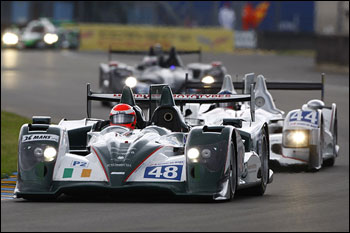 Dalziel had regained third under the pitstop, but Hartley was setting new fastest times for the #48 within two laps of taking over and closing fast. He duly retook the position, but then had to endure the frustration of more than an hour behind the safety car, following Anthony Davidson’s frightening accident at Mulsanne Corner. There was some compensation in the way the field was bunched up, and on the restart, Hartley easily took David Heinemeier Hansson in the #35 Oak for second in class, 9th overall.
More fastest laps and then, at just before ten on Saturday evening, Brendon Hartley moved into the class lead. Once ahead of the #24 Oak Morgan, Hartley was easing away to the tune of about ten or twelve seconds each lap, and had also moved into 7th position overall. There were a couple more swaps for the lead within pitstops, but essentially, the #48 Murphy Prototpyes Oreca was heading P2. For the next three hours the green and white car held the class lead. Hartley handed back to Hughes, and even after the pitstop, the #48 was still in front, confirming the advantage that Hartley had established over the #24 Oak in second. Then, at just after midnight, Hughes sustained a puncture and had to pit for fresh tyres and a new rear deck. The original had been damaged by the disintegrating tyre, and it took nearly nine minutes to make good all the damage. Despite the setback and the loss of three or four laps, Jody Firth returned to the track still holding 9th place, 16th overall, and with fifteen hours to go. Inside two of those, Firth had recovered to 6th, and was ready to hand on to Brendon Hartley. More impressive times came from the 22-year-old, including a 3:40.770 that would ultimately prove to be the fastest set by the #48, and one of the quickest P2 laps of the race. At just on half-four, everything went wrong for Murphy Prototypes. Slicing through the final element of the Porsche Curves, and heading down towards the Ford Chicane, Hartley sensed a sudden twitch from the rear end of the car. As he lined up for the apex on the next left-hander, the rear suspension gave way, pitching the Oreca into a spin from which Hartley would never recover. He managed to get the engine fired up, but only one rear wheel was still turning, and the car couldn’t be coaxed those few yards to the pitlane. Even hauled back to a place of safety, Hartley persevered, but Murphy’s race was over. We’ll tell a fuller tale in the Murphy race report, to follow shortly. In the meantime, it is interesting to note that the Murphy Prototypes Oreca was the fastest of all the LMP2 cars in a straight line, and by some margin; 12 kph in fact. Jody Firth was clocked at 320.4 kph (almost exactly 200 mph), 9th fastest overall and third quickest of the petrol-powered cars, behind the two P1 HPDs. Impressive stuff. 17 #31 Lotus, Lola B12/80 Coupé Lotus. Thomas Holzer, Mirco Schultis, Luca Moro Hour | 0 | 1 | 2 | 3 | 4 | 5 | 6 | 7 | |  |
|
|









