Paul Ricard Test Days – Prototype Round Up
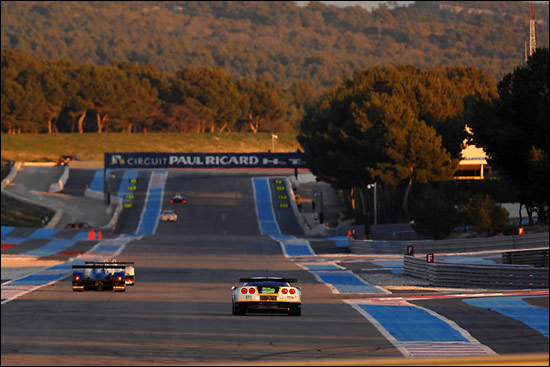
The Bar Has Indeed Been Raised One theme of the Monday lunchtime press conference was the supply of information that has typically been available to the media at Le Mans Series races during the last four seasons. The organisers have tasked the Infos-course organisation to make more information available – but to be honest, we’ve never been short of information. With up to 46 or so cars at each meeting, we hurry down pit-lane and find out what’s been going on. Perhaps from this season onwards, we won’t have to use up so much energy finding the answers. It was ironic then that we were at the High Tech Test Track, yet the supply of information was almost as unsatisfactory as in past years. Last season, Michael Cotton was extremely frustrated at a timing screen which only showed the fastest 19 cars. This time, we had lap times for all of the cars, but had to piece together who was driving what, we had long delays at times before printed results were available, and when they were produced, they showed what the screen showed – only the best time so far (in all sessions) for each car, not its best time from the latest session.. until the last one of the day, which did show the final session times.. when perhaps it might have shown the overall combined times. Anyway, with the odd, inevitable mistake during the event, we did try to keep on top of the running situation as regards best times for each car – and now with the benefit of a little hindsight, and some information from the last session (which we didn’t explore at the time, the Ed. sitting there writing up the morning’s text), we can now round up the whole event. Despite the niggles, above, it’s worth stating what a pleasure it is to follow a two day test like this. There were some garages we didn’t get time to visit – but one that we did visit was at 2am. Well done Hans Reiter and team, for being available in the small hours. Hugues de Chaunac preferred to wait until daylight to pass on his team’s account of testing, but we didn’t get a chance to return. So class by class (prototypes now, GTs in a second piece), with some other comments at the end of the GT summary. LMP1
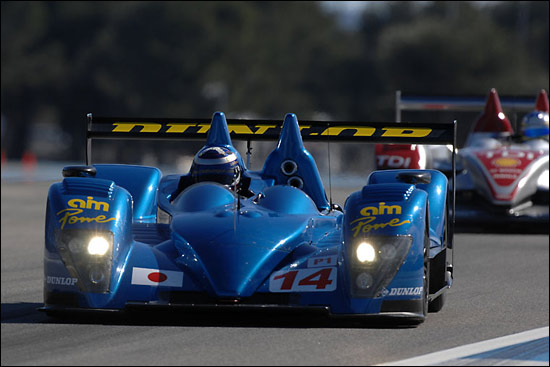
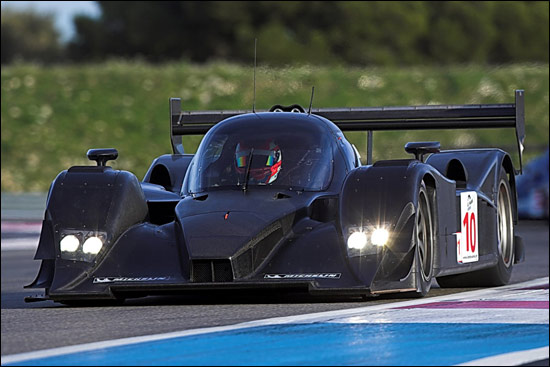
LMP1 was always going to be Audi’s party at the top of the timesheets. We managed to discover that Peugeot has lapped this same version of the track in 1:38.9 recently, so eight-tenths quicker than Allan McNish’s best on Sunday (1:39.705). It appears that the Scot was running low fuel and soft rubber, while Alexandre Premat was about a second slower, running much more fuel, and medium tyres. It would have been a thrill to see Audi against Peugeot at Ricard, but we can be patient: we’ll wait until Sebring. Comparing times with those at Ricard a year ago, particularly at the front, seems a little pointless. A year ago, the 908s weren’t up to speed (1:43.7), and barely pipped the petrols (Rollcentre, 1:44.0). Now the 908 is nearly five seconds faster, while the best of the petrols (Creation, henceforth to be called Creation AIM) was down to a thoroughly impressive 1:41.797 – which was perhaps half a second slower than it might have been thanks to traffic. This was the latest Dunlop race rubber on the car, as tested at Estoril. The P2s couldn’t be expected to threaten here, with their relative lack of power for the Mistral, but perhaps we’re seeing the first signs that the P1 petrol cars are going to be stronger/faster this year. Creation AIM certainly is. This is the team that was building its own car 12 months ago, and made a debut with it at Le Mans. That was a huge undertaking, but the following months saw the CA07 Judd running better and better – and now we’re really seeing the fruits of this programme. The AIM engine has been running faultlessly, thousands of kilometres have been covered in testing – and here was a team that didn’t need to run the 24 hour Ricard test that it had originally planned. A clutch issue on Sunday morning was irritating, but after that, JC-W and Stuart Hall were flying. Unknown to us at the time (and had we stayed to the end of the final session, then rushed to the airport, we probably still wouldn’t have known), Creation AIM fitted Le Mans bodywork to the CA07 on Monday afternoon – and JC-W whistled down the Mistral at 334.7 kph! “Sh1t that’s quick!” was Campbell-Walter’s comment afterwards. We’re not absolutely sure what Harold Primat said, as he travelled down the chute at 311 kph – and was passed at huge speed by the CA07. Sacre bleue perhaps? Creation didn’t try the Le Mans bodywork last June, but by having it ready since then, here they were demonstrating its effectiveness – and then some. The best lap with it was a 1:44, so clearly it wasn’t ideal for Ricard, “and we’ll need to add some downforce for Le Mans,” comments Ian Bickerton (otherwise it won’t get round the Porsche Curves), but what a prospect we have in store for June, for this car (and the Autocon entry). 335 kph is way quicker than anything at Le Mans in recent years (Nasamax the last car to go this fast?), and 330 kph would still leave it quicker in a straight line than everything else was last year. So Amanda Stretton – you weren’t the fastest driver on the Mistral Straight, but you were on Sunday, with 318 kph. Incidentally, Janos Wimpffen reckons the most famous husband-wife sportscar pairing from the past was Alejandro De Tomaso and Isabelle Haskell, but we’ll have to look into that in more detail. Poor Gareth Evans missed the test through illness, but Bob and Amanda (they ought to have a windscreen strip made up) were enjoying themselves immensely. Bob liked the consistency of the Lola on Dunlops, Amanda felt that 318 kph didn’t feel that fast (until she passed other prototypes) – and they were heading home happy by Monday lunchtime. As explained, we haven’t got the full Courage-ORECA position – but the team’s website is already up to date with the news. The 24 hour test saw a couple of (transmission/ECU) glitches, but the #5 LC70 set the fourth best time, a 1:41.805. This was one was being used for set-up and speed testing, #6 for reliability – and fourth fastest was impressive, the team having more developments up is Gallic sleeves, and planning more testing before Barcelona. P1 (petrol) is going to be ever more competitive this year... And there are the two, new coupes too. We won’t pester GH-C on what is hopefully a pause before the Aston Martin group test at Ricard, but it was logically Stefan Mucke who set the fifth fastest overall 1:42.105. Very, very impressive for the Lola Aston Martin. Mucke suggested that the Audis were gaining a second on the Mistral Straight sector, but then you wouldn’t expect even the larger-restrictored Aston Martin V12 to compete with the pulling power of a diesel V12’s torque. Remember, the diesels aren’t quick on top speed, but they do get there much quicker, thanks to all that torque out of the previous corner. Ah, a press release confirms that it was Mucke setting the best time. GH-C: “Everything has gone really well today (Monday). We worked on the set-up this morning to get a better balance. This afternoon we ran three stints, one each for Tomas, Stefan and Jan, with no problems except rubber in the radiator ducts. We finished this afternoon as the fastest runner when Stefan set a 1:42.1, compared to best time of 1'39.7 set by Audi last night. We’re very pleased with progress.” Tomas Enge: “I have to say that it is becoming my favourite toy! It’s great the way you can drift with it, even in the long corners. The car has been improving and I believe that we will be able to sort out even the smallest details before the races.” Henri Pescarolo explained yesterday that he wasn’t seeking a fast Ricard lap time, but was having his Pescarolo set up for different sectors, as he instituted a programme that should pay dividends on more conventional circuits, as well as on the straights at Monza and Le Mans. He seemed happy enough – but inevitably, he turned the conversation to the diesels, and suggested that they’ll be even more dominant this year, despite regulation changes (and petrol P1 improvements) because the diesel engines will benefit from a year’s development. They’re still fairly new technology, in racing terms, and that’s when the big gains come, early on. We’ll see if he’s right: Audi against Peugeot might hurry developments along too. The Charouz Cytosport Lola was slightly slower at Ricard than last year, but the smiles were wide ones from Gregg Pickett: this man loves his racing. Sam Hignett is enjoying more American influences in his life (he looked like a NASCAR team manager to me), but any future marital pressures are less than we thought: Maya has a UK visa until October 2009, not 2008. Hignett is a changed man though: watch him ignore pretty girls walking by, it’s quite astonishing... (can you hear him saying “you bastard Cracknell” as he reads this?). Martin Short was not a particularly happy bunny at Ricard, as he tried seven drivers while exploring his Le Mans / Le Mans Series options, and evaluated the new nose, and other changes, ahead of the second season with the Rollcentre Pescarolo. This is testing, so don’t set too much store by lap times. It’s race performance and reliability that count, and Short has that 2007 Le Mans result, fourth, as his marker of form. The Saulnier Racing Pescarolo looks as though it will get a spot among the 55 at Le Mans (it’s first reserve), so former VdeV racers Richard Hein and Marc Faggionato will probably get to race at Le Mans, with Jacques Nicolet, but how fast will they be? We’ll never know why the second Creation is listed as fifth reserve, but all the team can do is carry on in the same vein as in the last few months, and see where that takes it for 2008. The Epsilon-Euskadi eventually found some form on day two, with a 1:45.351, after a frustrating Sunday with the ever so new machine. It wouldn’t fire on the button, and wasn’t allowed to be bump started, but the ex-F1 men behind the team (Joan Villadelprat and Sergio Rinland – the latter was going to be the man with the plans at Team Modena) got things going on Monday. This car is very, very new: let’s give them some time. The team gave a presentation at the press conference, which helped to explain the technical basis of this organisation in the future – which decided on prototype racing as its focus because “Indy is too far away and F1 is too expensive”. Villadelprat is from Barcelona, so what better place for the new coupe to make its debut? LMP2
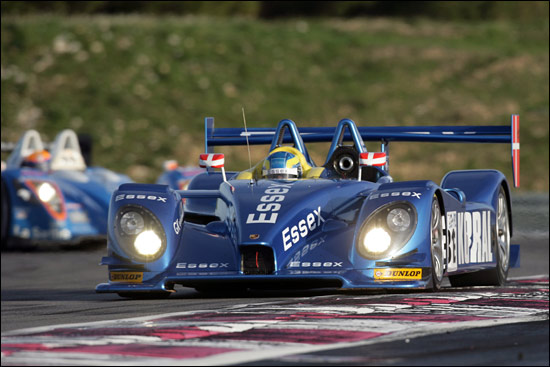
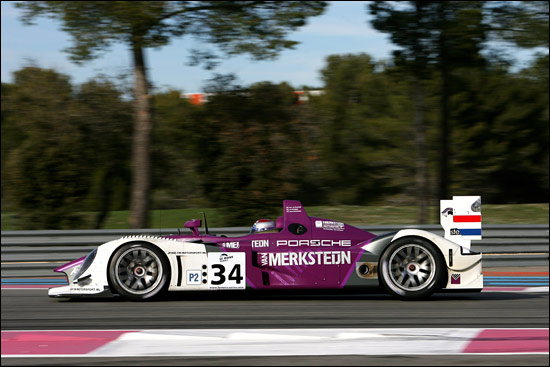
If the bar has been raised in LMP1, so too has the arrival of the Porsches raised the LMP2 class level. After two days of testing it was Jeroen Bleekemolen who clocked the fastest time in class – 1.43.829 - in the van Merksteijn Motorsport Spyder, just a tenth ahead of the similar Essex Porsche. Casper Elgaard set the time in John Nielsen’s Dunlop-shod car, barely a tenth slower than the (Michelin) Dutch RS Spyder. Dunlop is making great strides in the P1 and P2 classes, after GT2 success with Virgo last year. The Porsches allegedly reached about 280 kph along the Mistral (or perhaps more like the high 290s), way down on P1 speeds, but were very impressive through the slower stuff. That Porsche chassis is the business, and Jeroen Bleekemolen was loving being in a pace-setting car (the van Merksteijn entry). However, the Dutch team’s emphasis was not on setting fast lap times, but rather getting more experience with the new car and trying out different set-up configurations. On Sunday evening, the team simulated a complete race distance of 1000 kilometres, including pit stops for tyre and driver changes and this test went without any problems - as well. Buy an RS Spyder, do some testing, go racing – simple. Peter van Merksteijn: “This test was fantastic again! I have been able to do a lot of driving and my feeling for the car is getting better and better every time. By thoroughly analysing the data, I am able to improve myself fairly quickly, so that the difference between Jeroen and Jos and me becomes less. I am getting more and more confident and I am already looking forward to the first race!” Olivier Pla ended up exactly half a second down on the Essex Porsche, third quickest in P2 in the Quifel-ASM Lola (also Dunlop shod). Pla and Guy Smith, in a very well-engineered Lola, are a good guide as to the relative pace of the RS Spyders in Europe. There’s new bodywork coming for the Lola, but for now the team was testing suspension set-ups, weight distribution and ride height, with Alan Mugglestone in charge of the adjustments. We gave plenty of space to the new Speedy Sebah Lola coupe during our test days coverage, so until the drivers are confirmed, it just remains to say that it’s early days, but if a car goes this well out of the box, it bodes very well for its future form. Fourth fastest in P2 was less significant than its 1:46.321, which was almost two seconds down, after just two days’ running, on the tried and tested ASM B05/40. The Bruichladdich Radical seems unlikely to have Stuart Moseley racing it this year (or Tim Greaves), but there’s a queue of drivers to be in the Radical AER for the Le Mans Series and Le Mans. Marc Rostan has signed to drive the SR9 in the LMS. The RML MG Lola story is a frustrating one. AER’s Mike Lancaster was at Marseille airport on Monday evening, and he hasn’t yet got the answers as to why the MG version of the AER in-line four should have suffered two engine problems (two engines) at Ricard. The other AER fours were adjusted in case it was a fuel problem. No doubt it will all be resolved in good time for Barcelona. As will repairs to Karim Ojjeh's (mother's) Zytek, which he crunched on cold tyres on Sunday morning. The new Lucchini did get in 17 laps on the final afternoon, with a best of 2:03.997. GT1, GT2 and other round up comments to come – in a day or so.
MC |