ELMS, 6 Hours of Le Castellet - Murphy Prototypes on Track There were lots of teams with new cars and new names at Paul Ricard last weekend for the opening round of this season’s European Le Mans Series, and one of those was Murphy Prototypes. The car was brand new – hardly turned a wheel before it arrived at the track – and so was the name, with Greg Murphy lending his moniker and Irish-inspired colour scheme to what had been, in effect, Team RLR M-Sport in 2011. If much of the topping was fresh, the filling was instantly recognisable. Most of the faces looked familiar; hardened veterans, experienced and canny, wise to the nip and tuck of endurance racing, and just delighted to be back at a racetrack and tending a car with all the right credentials. 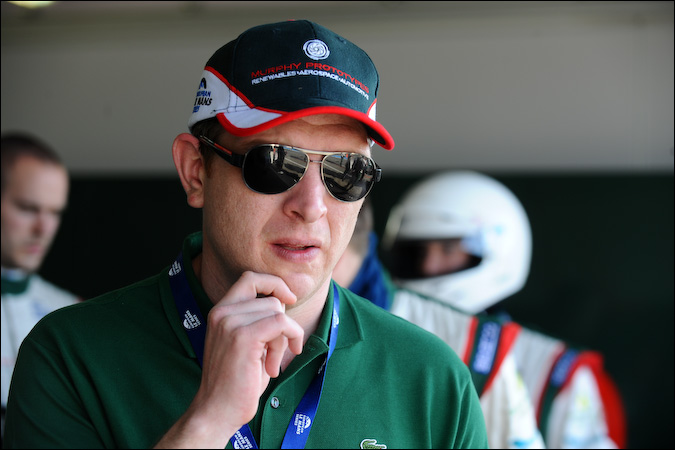 |
Seeing a driver of Warren Hughes’ calibre back in the cockpit of a chassis with regular podium potential should be something to delight British sportscar fans, and he’s likely to be fairly chuffed as well. Since winning Le Mans with RML in 2005, Warren ’s had to work hard for his living, often having to extract impressive performances from machinery that wasn’t quite the whole package. This year he not only has the car, but the backing and the co-drivers. He and Jody Firth have been regular driving partners for several years now, since their Embassy Racing days, via WFR and even some stints in the Speed Series. In 2011 Warren gave the venerable MG Lola EX265 a swansong year, but Jody was one of the first to get a hand on one of the new breed; the Oreca 03 Nissan. He partnered Mathias Beche and Pierre Thiriet at TDS Racing in the Le Mans Series and consistently impressed with his pace and flair – perhaps to the surprise of some. His opening stint at Imola was one of the highlights of the season.  |
Bringing the two of them together creates the basis for one of the strongest driver squads in what is arguably the most competitive and exciting P2 grid we’ve seen in years - perhaps ever. So it must be disconcerting for some of the rival teams to see that the third element in the Murphy Prototypes driving line-up is far from being a weak link. Luca Moro may be a relatively new addition to the LMP racing ranks, but on the form he showed in practice, and during his abbreviated race stint, he gives every sign of being pacey and quick-thinking. For some background on Greg Murphy and the team, check the Interview posted here last Saturday. That was uploaded just before qualifying, when some minor issues with the car meant a lower than hoped-for grid position for Warren . So, the Tynesider lined up on the third row for the start of the Six Hours of Le Castellet, behind Domink Kraihamer’s Oak Racing Morgan, and with Pierre Kaffer and the Pecom Racing Oreca alongside. Out at the front Yalmer Buurman got the jump on Mathias Beche, crossing the line narrowly ahead of the pole setter to take the lead into the first corner. Warren also got a great start, and was ahead of Kraihamer along the pit straight, but then got snagged up a blind alley as they hustled down into the first complex. “It was a really good start, and I was well up into the first corner,” recalled Warren . “The only trouble was, the view in the mirrors was diabolical, and I couldn’t see where anyone else was around me. I couldn’t defend the line easily, just in case someone was in the blind spot. I got absolutely hung out to dry by Tom (Kimber-Smith, who swept across from the second row), and then Kraihamer and Kaffer both got back past me; Kaffer through Signes. By the end of the first lap I’d lost all my momentum.”  |
Not only did Warren lose all that initial gain, but Sam Hancock detected an opening as well, and the Jota Zytek was next to swoop, snatching sixth, and leaving the Murphy Prototype Oreca one-down on its starting position. Warren wasn’t a happy bunny, but he got his head down, and stuck to the back of Hancock’s white Zytek like glue. “I shouldn’t have allowed myself to get into that position,” admitted Hughes. “We’re going to have to do something with those mirrors before the next race, that’s for certain! Once the race had settled down, and I could work out where everyone else was, I was able to pick up the pace. I was so much quicker than Sam (Hancock), but that Zytek’s quick down the straights. I could catch him through the corners, but every time we got onto the Mistral, he was away. I just couldn’t get by.” Just how much quicker was evident by the sector times Warren was setting. His third first-sector was significantly the fastest of the race so far, yet he could only close on the #38, but never be near enough to find the opening. Meanwhile, the gap ahead, between Hancock and Kraihamer in the lurid pink and black Oak, was stretching steadily. For more than twenty minutes (and Warren reckons it was ten laps) the two cars were nose-to-tail, Hughes bobbing and weaving through the twisty bits, looking for the gap, or hoping to unsettle Hancock and force the error, but left trailing down the Mistral. “I finally managed to get my nose fractionally in front and thought, it’s mine now – I’m not sitting here for another ten laps!” True to his word, Warren was through to sixth. “As soon as I got by, the car had so much more grip. I’d been trapped in the dirty air behind the Zytek for such a long time, with the car losing downforce, but without Sam there, I was able to pull away easily.” It was like watching a cork fly loose from a bottle of champagne, with Hughes popping off into the distance. He extended the margin by almost 5 seconds in his first lap of freedom. Having moved ahead of the Jota Zytek, Warren used his impressive burst of speed to bear down on Kaffer for fifth. Ten minutes after taking sixth, Hughes passed Kaffer for firth. “ Warren was one of the quickest on the track,” said an elated Greg Murphy. “For a good six or seven laps we were jumping up and down with excitement!” What came into play next was the surprisingly frugal demand for fuel from the Oreca’s Nissan engine. “I wasn’t taking it easy, but the car seemed able to go two or three laps further than the rest on each tank. I thought it might be down to the tow effect after being stuck behind Sam for so long during that first stint, but the second stint was just as good.” As all the other front-runners headed for the pitlane, to take on fuel, Warren cruised on regardless. With nigh on fifty minutes completed, Hughes eased through into the overall lead, the single blue light glowing brightly on the side of the Murphy Prototype. Hughes led for a lap, but it was still a significant two minutes for the team on its first outing. Next time around Warren steered the #18 into the pits for what should have been a straightforward stop for fuel and tyres. All went well to begin with, and dumped back down off the jacks, Warren went for the starter . . . and nothing happened. With the noise of the race going on all around, even the click from the starter motor was inaudible. Much to Warren ’s evident frustration, the Oreca was swiftly wheeled backwards into the garage, but mere moments later the green and white car was hustled back out again and the engine fired into life. “Luca had a very similar problem in the warm-up, with the engine refusing to restart,” explained Warren later. “The data suggested that everything was fine, but it still wouldn’t fire up. We swapped the starter motor before the race, but the fact it happened again during the pitstop suggests it’s something in the loom. There’s nothing the team could have done about it in then time we had available, but I’m sure they’ll have it sorted before the next run!”  |
All Warren ’s hard work went for nothing, and by the time the pitstops unravelled, the Murphy Prototypes Oreca had dropped back to 9th. “The problem at that pitstop was heartbreaking. We had such good momentum up to that point, and then we lost it,” said Murphy. “ Warren was furious, but once we’d got it going again, he just drove so well. It was incredible. There was too much ground to make up, although Warren was making a great attempt at doing it. Unfortunately, that put us all on the back foot.” Each stint in the #18 was lasting forty-eight or fifty minutes, and at 13:38 Warren brought the car back down the pitlane to complete his second stint, and hand over to Luca Moro. 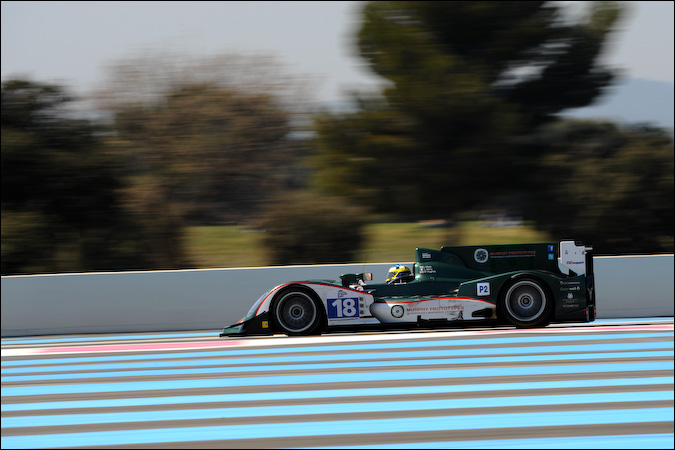 |
With precious little time in the car, Luca knuckled down fairly swiftly, and began turning in some highly respectable times aboard the Murphy Oreca Nissan. With the longer run inherent in the Murphy Oreca, Warren had risen to fifth or sixth in the final laps of his stint, as others pitted, but in reality, the car was still holding ninth. Sadly, despite steadily improving times, Luca would not be given the opportunity to prove himself - not this time anyway – and with the race just five minutes into its second hour, the Italian received an alarming radio call from the pits. The car was on fire. “We were lucky that Nick (Reynolds) spotted the flames long before they took hold, and he was able to radio through to Luca and tell him to stop,” said Warren . “Luca wouldn’t have known much about it – the mirrors are so bad, you can’t see anything like that when it’s happening behind you.” To his credit and quick thinking, Luca steered the car across to the side of the track just beyond Turn 2, and headed straight for the nearest marshal’s post. He leaped out of the car, and the fire extinguishers were right to hand, ensuring the flames were out and under control in seconds. “Luca’s quick reactions certainly saved the car from more serious damage” acknowledged Greg, relieved to see the car largely intact. There’s been no official word from Oreca since, but the assumption in the paddock is that the Murphy car suffered the same exhaust fracture that befell the Boutsen car on Saturday, and was caught early (before igniting the bodywork) in the Sebastien Loeb Oreca as well. Evidently, a fault that will need addressing before the cars go racing again. A disappointing end to what had been a very promising debut from the new team. “The car does look a bit sorry for itself now,” suggested a still-smiling Greg Murphy. “Obviously we’re very disappointed not to have finished, but that aside, I think we demonstrated that we’ve got a good turn of speed, and I believe we have a very competitive season ahead of us.” Of the trio, it was Jody Firth who missed out the most on track time during the weekend. “I only did eleven laps in total, and most of those were out and straight back in again. That was just in the nature of the circumstances. In effect, this was our first test session, and while that’s not ideal, we were able to see from the pace that Warren demonstrated that the car is working well and we’re able to run at the front.” Having raced the Oreca last year, Firth has first-hand experience and is able to judge exactly how well new 2012-compliant chassis compares. “I think Oreca have done an excellent job of recovering any loss of downforce associated with the louvre cut-outs,” he said, “They’ve created a very aerodynamically efficient package that feels sharp and very responsive, and should be competitive wherever the calendar takes us.” That poses the question, where next? Talking to Greg Murphy on Sunday morning, before the race, he was undecided about joining the WEC at Spa. “It is very tempting, I won’t deny it, but there are difficulties for us. One of my drivers is already going to be racing there, and the other two don’t appear to be so keen.” Luca Moro is signed to drive the Lotus LMP2, but the tune being played by the Hughes and Firth changed following the race, and after they’d both seen the potential of the car. “What we lack is track time in testing,” insisted Firth. “What with the noise constraints and other considerations, you really do have to go into Europe to find the circuits where you can address the development issues in a new car. You either do that, or you can go racing. Obviously, I’d rather do the racing, but Greg has to decide whether it makes financial sense for him to take the car to Spa. The decision is in Greg’s hands now.” Despite any reticence he may have felt, the performance of the Murphy Prototype Oreca Nissan at Paul Ricard must give Greg confidence for the future of the programme. The car was patently very quick, and in the hands of three such capable drivers, has to be a real contender for outright wins in the European Le Mans Series. It would also be immensely satisfying to join the grid at Spa, along with the other select group thought to be considering the move, and demonstrate the strength of this ELMS field, head-to-head against the WEC entrants.  |
“I still think, despite the delayed pitstop, we’d have been there fighting for a win at the end,” insisted Warren Hughes after the race. “Luca was going even better in the race than he had in practice, and the prospects were starting to look very encouraging. I feel like I’ve waited a very long time to be back in a competitive P2 car. Now that we have got a car with a real chance of winning, I just hope we don’t miss out on any more opportunities like this one.” |


