ALMS – Petit Le Mans – Round-Up Part 1
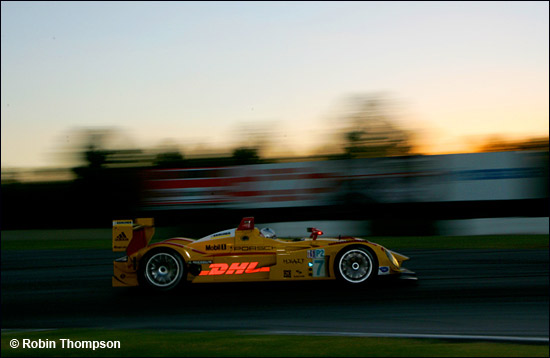
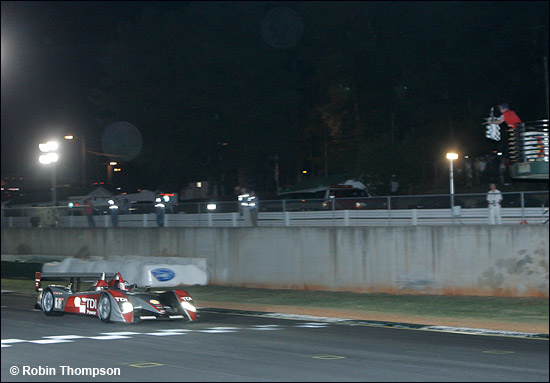
That Race For The Flag Robin Liddell, joining John Hindhaugh for the Radio Web commentary, made the point during the tenth Petit Le Mans to the effect that it’s long enough to be a real endurance race, but not so long that it becomes a hugely drawn out affair. Nine to ten hours is certainly enough around Road Atlanta – and with so many cautions and incidents during the first six hours or so, that turned out to be the prelude to the real race, the one to the flag. Ignoring the rest of the field for the moment (see Gary Horrocks' re-cap of the event), this is how the battle between the #1 Audi and the #7 Porsche unfolded. 6 hours 49 minutes – Timo Bernhard sets the fastest lap (so far) for the #7 car, a 1:10.408. Moments later, Allan McNish sets a 1:09.482. That wasn’t quite the fastest lap for the Audi up to this point, but that (almost) one second gap in lap times pin-points a significant difference between the two cars. McNish then puts Bernhard a lap down, passing the Penske Porsche on the back straight (a favourite passing spot for Audis - perhaps the only passing spot?). 7 hours 11 minutes – McNish sets the fastest lap of the race, a 1:09.195, and then pits, for Capello to finish the race in #1. The Audi still leads, by 21 seconds, with effectively a pit stop in hand. The #61 Krohn / Risi Ferrari is in the gravel again, at Turn 10A, which initiates caution no. 8. Bernhard pits under the Safety Car (the timing of which turns out to be just about perfect for the Penske car), and it’s also no trouble at all for Dumas to get back out on the same lap as Capello, about ten cars behind the Audi. That one lap advantage for the Audi has become just a few seconds. 7 hours 25 – racing again, and with Dumas in among those ten cars, his first racing lap is a 1:21, Capello’s a 1:13. A ten second gap then grows to 15 seconds within five or six laps. But Capello’s lead only grows to 22 seconds half an hour after the re-start, and it turns out he wasn’t happy with his tyres after that caution period. 8 hours 9 minutes – Capello pits (343 laps - 61 remaining), and Dumas leads (for the first time in this last third of the race) – by about 50 seconds. The Porsche had pitted later for its previous stop, and with its larger fuel tank, it seems possible that the timing of remaining fuel stops will be the significant factor in the outcome of this one. 8 hours 15 minutes - Dumas leads by 45 seconds, and the gap then grows a little. It really does look advantage Penske. 352 laps – Dumas pits, and with 42 laps to go (say 50 minutes), he can go to the finish. 353 laps – Capello leads, but only by 29 seconds, and he definitely needs another stop. 357 laps – Having teased out the gap back to Dumas, Capello pits – only 14 laps after his last stop. He is fuelled to the finish, and takes left side tyres only. It’s the left rear that has been taking a hammering this week. 358 laps – Positions are reversed, Dumas leading by 29 seconds. If it’s a simple race to the finish, it still looks like advantage Porsche: even more so as the gap grows on consecutive laps, from 29 to 31.3, to 33.0, to 34.8, to 37.0. But perhaps that was just traffic? Or getting used to new left side tyres? The gap then comes down – 35.4, then 34.1, then 31.0. Advantage Audi, with 29 laps left? Or all set for a last lap finish, bearing in mind that one second difference (on best lap times) – except that Capello could never keep that up in traffic, could he? John Hindhaugh is getting very excited. 366 laps – Maserati off exiting T12, full course caution. Advantage Audi now. 372 laps – the Audi is the ninth or tenth car in the train as racing resumes. Capello has a bunch of GT2 cars to navigate through, but after two racing laps he’s only 3.9 seconds behind. It’s a blast through the darkness, and the pace of these two is magnificent. This is sportscar racing at its finest – in the pitch black. The lap times are initially more or less the same, so on lap 375, there's still 3.3 seconds between them. The next three laps unravel like this: | Porsche | Audi | Gap | | Lap 376 | 1.11.403 | 1.11.406 | 3.3s | | Lap 377 | 1.11.187 | 1.10.955 | 3.1s | | Lap 378 | 1.12.604 | 1.11.629 | 2.1s |
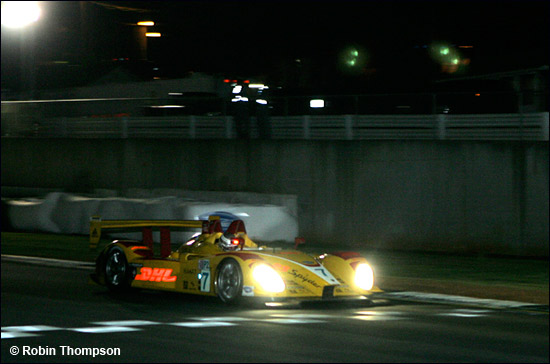
This image apparently shows Dumas just ahead of the Audi. And on the back straight, Capello blasts past, on lap 379. From the lap times, both are clearly delayed on that lap, but the scrap continues. When lapped traffic allows, the times get even quicker. | Audi | Porsche | Gap | | Lap 379 | 1.13.002 | 1.16.170 | 1.0s | | Lap 380 | 1.12.649 | 1.12.665 | 1.0s | | Lap 381 | 1.11.045 | 1.11.280 | 1.3s | | Lap 382 | ? * | ? * | 1.4s | | Lap 383 | 1.10.790 | 1.10.616 | 1.2s | | Lap 384 | 1.10.839 | 1.10.699 | 1.1s | | Lap 385 | 1.13.667 | 1.12.766 | 0.183s | | Lap 386 | 1.13.663 | 1.14.514 | 1.0s | | Lap 387 | 1.10.917 | 1.11.282 | 1.4s | | Lap 388 | 1.10.564 | 1.10.375 ** | 1.2s | | Lap 389 | 1.11.611 | 1.11.707 | 1.3s | | Lap 390 | 1.14.002 | 1.15.021 | 2.3s | | Lap 391 | 1.10.407 | 1.13.151 | 5.0s | | Lap 392 | 1.11.429 | 1.10.410 | 4.0s | | Lap 393 | 1.13.342 | 1.12.331 | 3.0s | | Lap 394 | 1.14.185 | 1.12.069 | 0.923s |
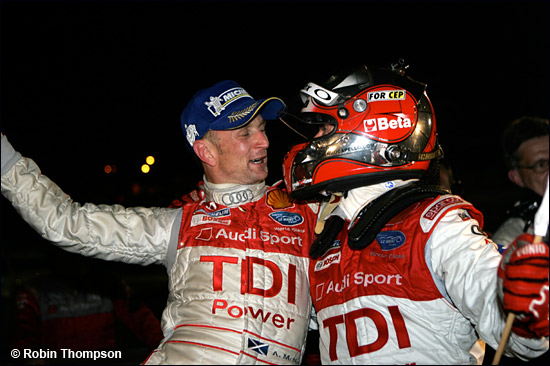
* Failed to record these laps, mainly because SPEED showed a replay, which appeared to indicate that Dumas had somehow got ahead of Capello, who then re-passed him. That didn't happen: it was a replay of the Audi's pass on lap 379. ** The #7 Porsche's fastest lap of the race. Notice that between them, Capello (five) and Dumas (four) set nine laps in the 1:10 bracket: this truly was remarkable racing between these two, in the darkness. Also remarkable was that Dumas refused to give up the race for the win. He could have settled for second overall, and the P2 drivers’ title, but he didn’t. He also set the #7’s best lap of the race. However, Dumas himself suggests that he was exhibiting a degree of caution that certainly wasn't apparent from the view on the TV screens - or the lap times: "There was no question of taking useless risks at the end. I evaluated the risks to be taken and I said to myself that it was not reasonable. I am a professional pilot, engaged to achieve goals which one lays down at the beginning of year with a whole team. It would have been stupid to risk everything. Our goal this weekend was to gain the victory in LM P2 to ensure our first place the championship in this category." And for Dumas at least, that was his first championship title, after 12 years of racing. They both had a ‘bobble’ on lap 390 (and 391 for Dumas, lapping the #20 Dyson Porsche), but the Frenchman then set a 1:10.410 to keep the pressure up. Somewhere here, Capello touched another car, to add to the drama. But as Janos Wimpffen pointed out afterwards, it was a thrilling Audi victory: has there ever been one of those before, in one of the big three (Sebring, Le Mans, PLM) endurance races? I can’t think of one. Normally Audi has crushed the opposition long before the last stint. “I can't think of any wins that felt better than this," said Dindo Capello afterwards. And for that perhaps we need to thank the ACO – because its LMP1/LMP2 regulations, applied in North America, did set up the most astonishing finish to an endurance race. It may not have been the ACO’s intention that a P2 should be right there at the end, but that’s the way it worked out. So from an IMSA point of view, the regulations did set up a scenario where the race between the big two was, and has been for much of the year, a finely balanced script. For eight consecutive races, Penske Porsches took the flag first, but the last two safety car periods on Saturday balanced out that contest, and it was the #1 Audi that deservingly and fittingly took the honours at Road Atlanta. The season-long fight between the Audis and the best of the P2s is in contrast to the one-sided nature of the ACO’s own Le Mans Series races: you couldn’t imagine such dominant affairs being allowed to take place in North America. Audi may have won its eighth consecutive Petit Le Mans, but boy did they have to work for this one, which made victory on Saturday the sweetest ever – and the most memorable. It will be very interesting to see what IMSA makes of the ACO’s 825 kg minimum weight for the LMP2s in 2008. Before that though, what dramas has Laguna Seca got in store for us?
MC |