FIA GT3 Silverstone – Race One For the second year in succession, the opening round of the FIA GT3 season was won by a Ferrari; this time the Kessel Racing 430 of Henri Moser and Gilled Vannelet. At times hard fought, this one lacked the dramas of 2006 but saw some excellent individual drives. Pre race, a couple of interesting news snippets were issued by the FIA stewards. The FIA Stewards have received (and accepted) a request for the #41 Spectrum Topspeed Mustang to be withdrawn from the meeting as a result of one driver (Dana Brewer) being unable to verify his competition licence. Could this be the very same Dana Brewer that issued a press release in February claiming that his team would enter the pair of ex Acemco Saleens in FIA GT? Could it also be the same Dana Brewer that failed to appear at Silverstone to take up a drive in a Graham Nash Saleen in 2005? Well yes it certainly could! The second concerned the decision to modify performance for three cars (for the Silverstone event only) as follows: “Ascari to take off 40 Kg.
Corvette to take off 60 Kg and to run a ride height as defined in the homologated technical form.
Viper to take off 20 Kg.” Whatever one’s personal thoughts on the GT3 class, it is hard to deny that the sight of 41 of these cars on a grid is impressive indeed; and this is without the glorious-looking Jaguars and the sinister Morgans - if ever a car was destined for a role as the getaway vehicle for the baddies in a gothic film noir, this was it. Unfortunately, the sight of 26 GT3s being pushed around by stewards for 15 minutes was less than impressive. Ian Khan’s #34 JMB Ferrari 430 had failed the ride-height check after qualifying (by 1mm apparently) and been demoted to the back of the grid. An appeal was lodged by the team, however, and the car would be reinstated in its qualifying position. Unfortunately, this meant that an amended grid was issued after the cars had formed up for the start of the race and all those cars from 17th downwards were on the wrong side of the track. The FIA’s preferred method of sorting this out – pushing the vehicles while stationary – probably did not make for scintillating live television.  |
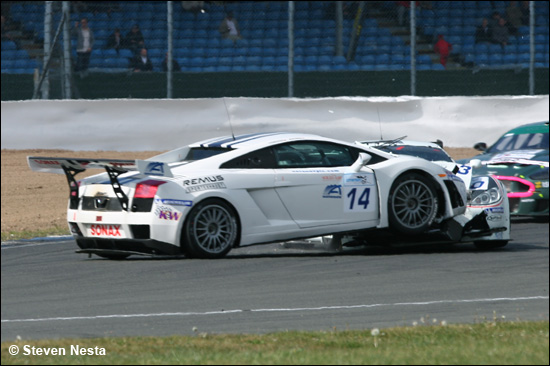
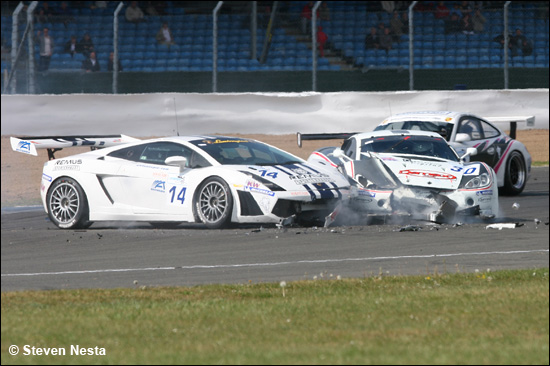
When the race did eventually start under its own steam, the pack made it through Copse in good order and without incident. Christoph Breuer did his best to make the opening lap more interesting by spinning the #39 Kessel Racing 430 in the middle of Maggots, and in front of 30 cars, but somehow managed to avoid even the slightest of contacts as he drifted backwards into the middle of the pack; plummeting down the field in the process. Romain Bera’s moment in the sun lasted less than a lap, as the #44 Matech Racing Ford GT (the unofficial winner, by the way, of the Best Looking and Sounding GT3 award, as nominated by a select bunch of journalists) lost the lead to Diego Alessi at Abbey when the BMS Aston #23 dived down the inside. Worse was to follow for Bera at the end of the second lap as the Ford slowed noticeably across the line and several places were lost. Just as it looked as though the car was in trouble, Bera speeded up again and held station in fifth; suggesting a missed gear was the cause of his misfortune. As the Ford slowed, the first car past was Richard Williams’ #5 Trackspeed Porsche 997. Having started from seventh on the grid, the Super Cup driver had made the most of the opening seven miles and deposed three Gallardos and a 430; no mean feat in a car that was clearly not the fastest marque of the 11 participating in the race. The Lamborghinis were by now beginning to sort themselves out after a poor start, with Erik Janis being the fastest of the leading trio in fourth, just behind Gilles Vannelet in the #38 Kessel Racing 430. Former skier Hans Knauss had nipped ahead of Nicholas Navarro in the opening laps (leaving the score at 2-0 to S-Berg over First) and was now challenging for fifth against the recovering Bera. Williams now found himself having to defend as his pursuers found their legs, but he could hang on for less than two laps before Erik Janis was in a position to challenge for the place. The #15 Gallardo was on the Porsches tail down the Hangar Straight and simply swept by as Williams braked for Stowe. Further round the same lap, Williams was to lose two more places as he was swamped by both Alessi and Knauss at the complex. Williams may have thought himself unfortunate to have lost those places, but his misfortune was as nothing compared to the traumas at Tech 9; whose entire race disintegrated in the opening 15 minutes. On only the fourth lap, both Tom Ferrier and Peter Snowdon pitted; the former with handling issues and the latter with contact damage, having been hit from behind by an Aston Martin, spun around and hit by the same car at the front causing damage to the radiator. Worse was to follow a few minutes later as Jonny Lang was also forced to pit with contact damage. All three cars briefly got going again, albeit with a second stop for #1, but both Lang and Snowdon had retired by the end of lap six. To add to his woes, Tech 9 boss Phil Hindley was also summoned to see the Race Director. Janis, having worked his way up to second, immediately tripped himself up with a moment somewhere that cost him four seconds and three places. He pulled himself together quickly, though, and retook fourth from Bera’s Ford at Stowe in a replay of his move on Williams. It was obvious that the brakes on the Gallardo were very, very good. Diego Alessi was defending his lead very convincingly and did not allow the gap to fall below two seconds at any stage. Martin Rich was enjoying his stint in the #28 Damax Ascari, keeping the KZR1 in strong contention in the top ten and in a position to challenge Luca Pirri’s #18 Corvette. Unfortunately for Rich, an incident at Priory involving another Damax car would prevent him from making a challenge. The TV cameras showed Jimmy Brodie’s #30 Ascari sitting on the track with the #14 Gallardo of Marius Ritskes buried in its side. The two cars were clearly unable to move off under their own power and the safety car took to the track. The amount of fluid pouring onto the tarmac at the complex would mean that this would be a lengthy period of slow running. With just nine laps run, the field had already lost half a dozen cars. In addition to the four already mentioned, Klaus Ludwig’s race had lasted just one lap before being forced to pit in the #16 Martini Callaway Corvette, while Erik Zwart retired the Belanga KZR1 at the end of lap six. Elsewhere in the pack, things were going better for certain individuals. Gilles Duqueine was belying his disabilities and had improved from 31st to 20th in the #7 RPM Viper; while
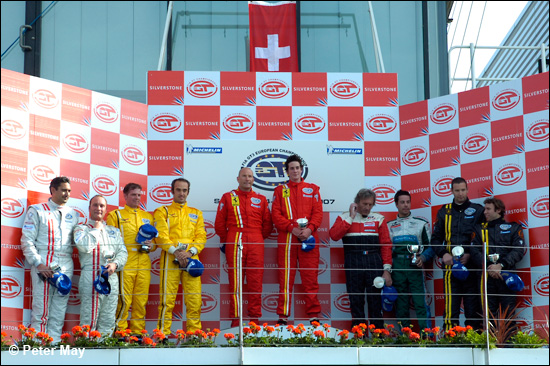
Paul Warren had made up 13 places in the #6 Trackspeed Porsche. After a couple of laps behind the safety car the pit window was opened. First to take advantage was the delayed #1 Porsche, which gained back some time as a result; but a dreadful decision by S-Berg and Matech was about to change the leaderboard significantly. As the safety car came past once again, both Janis and Bera stayed out, but every other car pitted, causing the pit lane to be a very busy place. With such a long lap, the field caught back up with the safety car well before it passed the pits again and when the Gallardo and the Ford pitted, they had effectively demoted themselves to the tail end of the race. As the numbers 44 and 15 caught up with the pack, the safety car peeled off and the racing resumed; 28 minutes remained. The #1 Tech 9 Porsche led on track but not in the race, and Phil Quaife moved off line down the Hangar Straight to allow the leaders by; those now being Andrew Thompson in the #28 Ascari, from Alex Frassinetti in the #23 Aston, from Henri Moser in the #38 Aston. Moser was simultaneously attacking the Aston ahead while defending from Juergen von Gartzen’s #18 Corvette. Martin Rich was delighted with his stint and the stop that had promoted his car into the lead, but his delight was to turn to dismay as the phrase “Stop/Go #28” flashed up on the timing screen. The Ascari was not alone, as numbers 4, 23 and 25 also found themselves penalised. “Everything was going brilliantly up to that point,” reflected Rich later. “We had prepared for the stop and had a stop watch strapped to the dash board. As I came in I hit the start button and when Andrew left the clock said 71 seconds. “But now we find out that they’ve moved the cones,” he continued. “Yesterday, they were at the 60km board and that’s where I hit the button; but today they have been moved forwards and our official stop time was 65 seconds.” Thompson rejoined, but was destined not to finish following gearbox trouble near the end of the race. “As it turned out, we learned a lesson for free,” said Rich. “If we had been leading when the gearbox went, we would have been devastated.” James Pickford was also ruing his premature departure from the pits that would result in the #4 Trackspeed Porsche finishing 14th, but was not downhearted. “Other than a fuel surge problem shortly after I joined in, the car was fantastic. We had stunning pace and would have finished in the top six without the penalty; we just can’t match the aero of the Lambos and the 430s.” After the four affected cars had taken their penalties, Henri Moser now led in the #38 Kessel racing Ferrari and was being pursued relentlessly by von Gartzen. James Ruffier was briefly the fastest man on the track, but his Corvette pitted on lap 17 with engine problems and was retired. Around the same time we lost both Ford GTs; they had the pace, but apparently not the durability. Stephane Daoudi was flying in the #34 JMB Ferrari, having taken over the car from Ian Khan after a very useful stint that had seen the car gain three places, and was soon all over von Gartzen. Second was his with ten minutes remaining. The stars of the latter stages of the race, however, were Frederic Makowiecki and Ulric Amado . Makowiecki had taken over the #26 Hexis Racing Aston Martin in 23rd place from Jean-Claude Lagniez and was demonstrating to great effect his gold driver status. He carved his way up through the field and was fourth as Daoudi took second; only slightly blotting his copy book by running wide at Copse and delaying him enough to prevent him mounting a challenge on the third place Corvette. Progressing quietly but impressively were Howard Spooner and Adrian Willmott in the #29 Damax Ascari - their pace would secure fifth place ovrall, and of course the best of the Ascaris. Amado, meanwhile, was wringing all he could out of the #11 First Racing Lambo, carving his way past the Ben Collins piloted Ascari and Werner Grobl’s Gallardo in the latter stages on his way to sixth; he also set the fastest lap of the race in the process. At the front, Henri Moser was driving impressively to defend the lead, and Daoudi was struggling to close the gap to the similar car. The gap was coming down, but by just a few tenths a lap and it was clear that he would need more time than was available. The 19 year old Moser hung on to win by 1.802 seconds. “I am very happy to win at Silverstone,” said Moser. “I had my first ever race here in the Ferrari Challenge last year and I’m really happy. Gilles had a fantastic start and gave me the car in perfect condition; I had the best conditions possible for my start. “I said to myself that I would do my best, and we didn’t know until yesterday how fast the other cars would go, so it’s a nice surprise to win.” Ian Khan’s and Stephane Daoudi’s delight at their second place was not to last very long, as the decision of the FIA stewards (number 28 of the meeting so far) was that the car had indeed infringed the ride-height regulations and would be excluded from the results. Alex Mortimer had had a good race in the #7 RPM Viper after taking over from Gilles Duqueine. Over the course of his stint, he rose from 20th to ninth, and was just four seconds away from a championship point at the flag. Gilles Duqueine: “This is a good team, that much is clear from the fact that all three cars came home. But starting from 31st place was a big problem!” Alex Mortimer: “We had to drive the car very, very hard to get that result. I still feel that we need a little more in terms of equalisation, even on the Michelins. They are though awesome, very consistent. I could push hard even at the end of the race. Gilles did a fantastic job in the first stint, my only real problem is that it is very tight in the cockpit with the hand control gear in place, we also have a problem with the brake pedal, when I press it I have to release it with my hand! We’ll put a bl***y great return spring on it though to sort that out.” All three RPM cars finished in the top 16, rounding off a satisfactory FIA debut for the team. The second half of the first race of the season had been somewhat anti-climactic, but the signs were there that this could be a very good season indeed. With rain forecast for Sunday’s race, anything could happen. |