Nurburgring – Post-race Moments
Some Humour From The ‘Ring
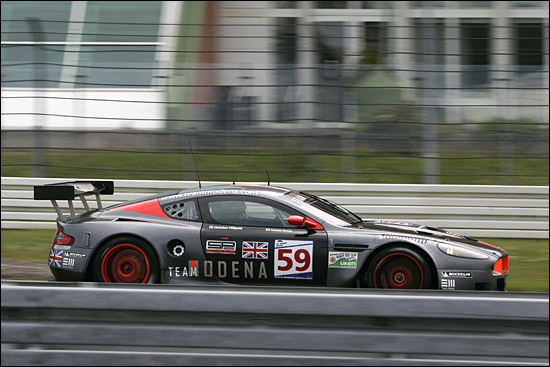
(And At Least One Serious Matter) This was intended to be an initial, light-hearted look back at the Nurburgring 1000 Kms – with more serious thoughts and conclusions to come. But one serious matter has arisen while we’ve been travelling back to the UK. The final result shows the Luc Alphand Corvette second in GT1 and the #50 Larbre Aston Martin third – which means no place for the Team Modena Aston Martin. We’ve been told that the scrutineers were asked to look at fuel capacities of GT1 cars, and in the course of that, post-race, it was discovered that the #59 car had a tank that was marginally too large. After an eventful weekend and a great race to what seemed like second, the Modena car no longer appears in the results. We haven't seen an official bulletin to confirm the fuel tank issue - or the reason why the Charouz Lola started from the back of the grid. Such things just don't seem to be explained officially. Right, back to the intended subject…. We thought that Bruno Famin had come up with the most amusing remark at the Nurburgring – with his reference to the fact that the LMP1 regulations are skewed in favour of the petrol cars. What we didn’t know at the time was that in the early laps of the race, the advantage to the diesels would be four seconds per lap of the Nurburgring. That was undoubtedly a factor when Henri Pescarolo came up with his brilliant post-race comment (referring to Famin’s comments): “I think that’s the most stupid thing I have ever heard.” This is the relevant text we posted on Friday:
Perhaps the most surprising and controversial comment in the session came from Bruno Famin, in confirming that some potential changes to the car were awaiting confirmation of the shape of the 2008 regulations he offered a clear opinion that “the regulations currently show a clear advantage to the petrol powered cars.” “The diesels are heavier, have much more of their weight to the back of the car, have different cooling needs and systems and all of this means making some major compromises. The conventional petrol powered cars are capable of much better performance as the regulations currently stand.” But on our four hour trip from the ‘Ring to Dunkirk, it was another Frenchman altogether who left us speechless. We’d just crossed from Belgium into France, and a complete airhead in a slate grey Golf pulled alongside the dsc machine and, making sure that the ‘man of the cloth’ David Lord had wound down his window, shouted “It is the same colour.” Yes, two Golfs the same colour – what an amazing coincidence…. And there were others: there alongside us was a dawdling Ian Bickerton, with Creation’s race engineer Ian Smith in the passenger seat. ‘Bicks’ put his foot down, and hurried off, presumably to Calais. John Hartshorne had given us a cheery wave as he motored past, while we were still in Germany, while in Belgium, we passed the Virgo truck: here was a very happy crew. There were some light-hearted moments immediately after the race, with JC-W confronting Joao Barbosa over a minor moment of contact between the two during the 1000 kms. It was amazing that there wasn’t more (contact), with all that traffic and rubber. Rollcentre’s Stuart Hall was struck on the helmet by a large lump of flying rubber during one of his stints, and radio’d the team to say what had happened, and that he now had a headache. The response from a caustic Martin Short was initially to ask if he wanted to come in for a driver change. “No, I just wanted a bit of sympathy.” “^^88%%$^^ GGg Jrr%££$$” was the gist of the response, because in taking up a Rollcentre drive, you shouldn’t expect a lot of sympathy! All the rubber pick-up might have had a significant effect on aerodynamics – as explained by Hugh Chamberlain. “That’s buggered up your aero.” Why’s that?” “There’s about 3.8 mm of rubber pick-up on the tyres (increasing the ground clearance)!” It was a funny old event all round. Who would have guessed beforehand that the Peugeots would have such an advantage? Perhaps it was partly a factor of a low grip circuit playing right into the hands of the team with massively more downforce than the rest? Then there’s the horsepower and torque advantage of course. Four seconds – in which other category of racing has one entrant had such an advantage? Can you think of one? Martin Short completely rubbished the Editor’s thoughts about tyres (that were specifically developed for the high torque / high downforce Peugeots), but I still believe that a tyre developed specifically for the petrol-fuelled LMP1s would allow them to at least close up some of the yawning margin. Was the race a yawn? Well yes in some ways – but what a great LMP1 race it would have been without the Peugeots. JC-W was due to take over the Creation for the last stint, but by then, the 07’s race was being managed relative to the closing Charouz Lola. The B07/10 pitted for a splash of fuel with about half an hour to go, so Shinji Nakano did the same: there wasn’t time for a driver change, and Shinji was left to try and hold off the Czech driver, while coping without traction control. He stayed ahead until the penultimate lap. Stuart Hall was involved here, because he was running faster than either of them, and had unlapped himself from the Czech Lola. That was the cue for a representative of the Lola team to ask Rollcentre to ask its driver to move aside. Er, it was the coming together between these two teams that caused a furore at Valencia in the late stages of that race.. but Hall did the right thing, as he wasn’t racing for position. Yves Courage’s cars had been (racing for position – and right in the thick of the petrol P1 action). So it was a shame to see Jonathan Cochet lurch into a tyre wall, apparently after the rear suspension broke, while the second disaster came in the last hour, with J-M Gounon in a gravel trap, after a self-confessed mistake. The TV feed switched to Yves Courage in the pit – and the constructor STILL had that slightly bemused smile across his face. In the same situation, the likes of Bickerton and Short would have been going off the clock. Here’s one for Janos Wimpffen: which driver didn’t race a prototype, because he was racing a Carrera Cup Porsche at Magny-Cours, and who took his place, after his (other) Dutch entry sadly burnt rather fiercely at T1?  Wouter Melissen clears this one up, and corrects a bizarre misunderstanding ..."It looks like you are suggesting that Peter Kox drove the final stint of the Dome, but it was really Jeroen wearing Kox's helmet. Apparently Jeroen's own helmet got damaged while used by Jan in the opening stint. The rest of our report can be found here:"
The next point is sad, rather than funny. The wonderful hotel that looked after us was also housing a good number of ‘petrol heads’ who were in the area for the weekend to thrash their cars around the Nordschleife. None of them knew anything about the event we were in Germany to cover.. Not surprising really, because the event didn’t seem to be promoted at all. But the good news is that the Silverstone 1000 Km on September 9 (sorry - it's the 16th - the Britcar 24 Hours is the 8th/9th) will be promoted, and we’ll bring more details (which will hopefully involve dsc readers, in a not to be missed opportunity) in due course. The last stage of our journey back to the UK was a miserable affair – stuck on a ferry outside Dover, thanks to delays caused by high winds, then stuck on the ludicrously overcrowded UK motorway network. What a pleasure it is to drive on the continent, on the whole – and to cover races on the continent too. But four seconds a lap…..
MC |