Le Mans Series – Spa 1000 Km Round Up
You Could Write A Book On These Races Well, you could if you could keep up with everything going on, in five hours and 48 minutes of drama at Spa. Safety Cars
One area where we have a problem at Spa is that, as mentioned at the 24 Hours, we have no view of the track – apart from a short stretch of Eau Rouge, seen out of the back of the media centre. That makes it very difficult when the Safety Cars appear, for example – which they did quite regularly. But it’s not just us struggling. The first Safety Car period saw the #77 Felbermayr-Proton Porsche lose two minutes to the Virgo Ferrari. The next Safety Car period saw the gap close right up again. Perhaps over the course of nearly six hours it does all even out, more or less, for most runners – but the two teams involved in the race for the win in GT2 seemed to be as confused as we were, regarding how they gained or lost time relative to their rivals.  |
Marc Lieb was bitterly unhappy to suddenly find he and Xavier Pompidou two minutes behind Rob Bell and Allan Simonsen. That first Safety car period was called, we believe, to remove a piece of bodywork from the track, through Blanchimont. Marc Lieb’s suggestion was to use the system they use at the Nurburgring: “Double waved yellows at the scene of the incident, and everyone has to slow down.” He rightly argued that the flow of the race is maintained, and no one can gain or lose any significant time to anyone else. Would it work in the Le Mans Series though? Perhaps it could be tried in a practice session, with everyone given due warning of what’s to come? A severe penalty for not slowing down would surely be a suitable deterrent. Major Incidents
Logically, Safety Cars would be called upon in the case of significant crashes – such as those befalling Jarek Janis and Raymond Narac. The Czech driver had a tyre go down at Eau Rouge, and it was a worrying time as a screen was held up – but after a check over, he was pronounced fit. So, fortunately, was Raymond Narac. Poor Narac has now suffered two big impacts in the Le Mans Series this season, both as a result of contact from prototypes. The first was at Valencia, the Saulnier Courage at fault – and this time it was Shinji Nakano in the Creation who hit the IMSA Porsche. The organisers take a dim view of prototype drivers who fail to show discretion when it comes to lapping GT cars... or even slower prototypes (the Lucchini being passed by a Peugeot). Nakano will not be driving the Creation again: expect another Japanese driver to be in the car at Silverstone, and perhaps a Brazilian at Interlagos. Significant Progress
A suspected puncture, and then a puncture, handicapped the Creation Judd in the first two stints, but the team was rightly very encouraged with the progress shown by the CA07. Revised suspension front and rear was working very well, and JC-W was mightily impressive in qualifying - and in the race. Shinji Nakano had his points removed for the team’s sixth-place finish – one that didn’t do justice to the team’s improved form. Exactly the same comment applies to Embassy Racing – sixth in LMP2. What might we have witnessed, but for the throttle problem with the SR9’s Judd engine? It could have been a brilliant finish between RML and Embassy: Warren Hughes set the fastest P2 lap of the race after the repair, and sixth was some consolation – but not much. The LMP2 Race
Hughes had split the top points scorers (RML and Quifel-ASM) in the early going, these three chased by Chris Buncombe, Stuart Moseley and Eric van de Poele. Binnie’s Allen Timpany described it as a “bitty” race, which in some respects was a term that applied to all four classes thanks to the Safety Car periods, but two delays for the #31 (electrical and a collision) prevented anything better than fifth at the flag. Juan Barazi was tapped into a spin on lap 2, by Bob Berridge, and with Michael Vergers driving last in the Zytek, it wasn’t until late on that this car came good – and then bad, as Vergers made a rash move to pass Burgueno, for second. This shot is from practice. The Lola and Zytek had anyway been well beaten for the win by Erdos and Newton, who are looking like P2 champions – but we’ve been there before. Losing the 2006 title at Jarama defied belief, but the MG Lola is as quick as anything, still, and two wins out of four races is championship form. They could seal the title at Silverstone. The Bruichladdich Radical had looked on course for a good finish, until a curious incident, followed soon afterwards by engine failure. Tim Greaves was defending his track position from a charging Norbert Siedler in the Kruse Pescarolo, but the #44 dived inside at the Rivage hairpin. Siedler was all locked up and slithered wide – then cut back inside, making firm contact with a Radical that was by now minding its own business on the racing line. Siedler spun, and he and Greaves were nose to nose, the Pescarolo rolling back into the path of an innocent Sean McInerney in the Chad Peninsula Panoz. Kai Kruse didn’t see it like that, but the in-car footage told the story, and both the Pescarolo and the Panoz were retirements with contact damage. McInerney had been making the white Panoz go like never before. The LMP1 Race
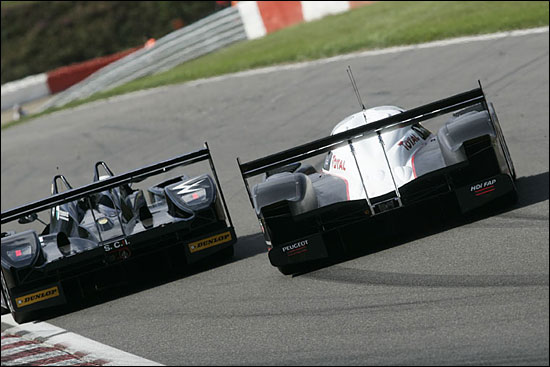
With the Peugeots certain to head off into the distance, we needed the petrol P1s to make a real race of it: we didn’t need the #12 Courage to take out the Charouz Lola at the first corner. Stefan Johansson was vocal in his criticism of that incident, but with Shimoda crashing out on the Racing Box Saleen’s oil in the second hour, there was another top car gone. Gounon’s Courage had clutch failure – so before much of the race had elapsed, we had a Peugeot leading, then Pescarolos 2-3-4 (here in practice, in the wrong order). The Tinseau / Primat car lost out to the RML entry for third overall (bad luck with the safety car, plus an oil leak), while Martin Short was seething at the starter motor problem that afflicted his Rollcentre Pescarolo. Here was another great run for the British Pescarolo, and Stuart Hall impresses ever more, with each event. That left Collard / Boullion in a lonely second. Henri’s team relentlessly gets this car home after really solid runs: it’s just like last year – except that there’s a Peugeot (or two) ahead of #16 in 2007. All this left the Chamberlain-Synergy Lola in fifth overall, this team as much as any knowing how to get a car to the chequered flag. The Charouz Lola was a rampant seventh – but what might have been? Interlagos
We didn’t spend time exploring who will and who won’t go to Interlagos – partly because we didn’t have time, partly because, early on in the meeting, there was a feeling that hardly anyone was prepared to make the commitment - yet. After Silverstone will be the appropriate time for decisions to be made. Patrick Peter is confident that he’ll be able to send 30 entries. Expecting (mainly) privateer entries to stump up the cost of that trip at the end of the season might be expecting too much. 50 Cars
The thought occurred, more than once while watching practice from the pits balcony overlooking the end of the pit straight and La Source, that here, in 2007, we have a superb Le Mans Series grid. 50 cars of all shapes and sizes is a wonderful spectacle – and the demand for entry places next year is going to be huge. So why change anything now (or for 2009/10)? Yves Courage’s cars had a rotten event here, but showed what they’re capable of at the Nurburgring, the Zytek and Creation are brand new cars, the LMP1 Lola is barely 18 months old, the Pescarolos are new – and all of them are approaching, or have reached, that point where they’re really refined examples of their breed. True, there aren’t enough manufacturers in P1 – but one of them doesn’t even want to race in the Le Mans Series. The privateers are the bulk of the P1 Class – and might have to race against untethered Peugeots for another year, before the diesels are slowed down? The race at the front, and the event, does lose something because of the Peugeot domination. GT1 And GT2
As a meeting takes place at the FIA in Paris to discuss wholesale changes to the GT classes (for FIA events), we have to wonder, what is wrong with the GT classes, in ACO-sanctioned events at least? GT2 in the LMS is already oversubscribed, while GT1 might well take care of itself – if even a couple of GT2 teams switch to GT1. Just over a year seems very short notice to advise teams that their GT cars are going to be ruled out of one field of GT racing. The Spa 24 Hours displayed a strong GT1 entry, as did Le Mans. GT teams have a choice – two hours or 1000 kilometres. The entrants will decide – perhaps that is the problem for the GT classes (in FIA events). Spa demonstrated that the strongest teams in both classes are becoming dominant: that’s Oreca in GT1 and Virgo and Felbermayr-Proton in GT2. Three cars – six professional drivers, is it as simple as that? It’s tough for the rivals of this group – but who would have thought that it would take this long for a Saleen to be so dominant? Porsche is now producing its fourth version of what we now call a GT2 car, Ferrari its second. That makes it particularly tough for Spyker and Panoz – so perhaps these small manufacturers should be given a modest performance boost? We don’t want to see just Porsches and Ferraris, do we? White Lines
A number of drivers were aggrieved at the penalties being handed out for allegedly crossing white lines – at Blanchimont, La Source and Raidillon. Surely they can’t have transgressed as often as was suggested by the officials? Yet other drivers were apparently not penalised for contact? The GT2 Race
We’ve mentioned the Safety Cars and their effect on the GT2 race – but the deciding moment in the battle between the #77 and #96 cars was Virgo’s decision to bring in the Ferrari for wets, as the rain fell. “Virgo could have been 100% right (in pitting),” comments Hugh Hayden. “I gambled in leaving Xavier on slicks. I went out the back of the pits and looked out towards Eau Rouge, and my opinion at that moment was that it wasn’t going to be wet enough for long enough to justify changing from slicks. Fortunately for us, that turned out to be the right decision.” The Virgo Ferrari pitted 20 or so minutes into a stint for a change of rubber, then ended up hanging on, on unsuitable rubber as the track dried, until they could make another stop for a full run to the flag. It’s going to be a great contest between these two entries right to the end of the season. |