A History Of Paul Ricard HTTT
And A Lap With AWOL © Marcus Potts For many years, between 1999 and 2009, the circuit was the exclusive domain of the Formula 1 teams, who were invited to use the circuit’s flexible layout configurations to mimic many of the world’s leading Grand Prix circuits, and thereby carry out intensive testing and preparation work. Changes in the regulations two years ago resulted in the banning of mid-season F1 testing, and with that, the raison d’etre for the Paul Ricard track diminished. But the preceding decade of intensive, secretive testing, had seen many hundreds of thousands of pounds invested in the circuit by the track’s owners, a company called Excelis, owned by Bernie Ecclestone and managed by Frenchman Philippe Gurdjian. Monsieur Gurdjian’s association with the Paul Ricard circuit pre-dates the involvement of the Ecclestone empire, and reaches back almost as far as the track’s conception in the late 1960s. As the name suggests, the circuit has close ties with the anise-based liqueurs that remain so universally popular in France. Paul Ricard, a member of the company’s original founding family, had a passion for motorsport, and wanted to build his own circuit, ostensibly to carry out some private research into road construction. He was mildly eccentric, as well as an astute businessman. Paul Ricard, the Man 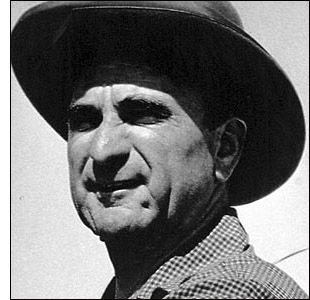 Born in 1909 in a rural suburb of Marseilles, not far from the site of today’s circuit, Paul was still only in his teens when he devised the liqueur that would ultimately become world famous as Ricard. Pastis-type drinks had been around for years, of course, but had become notoriously ill-refined and dangerous, to the point that they were banned in 1915 for fear that the effects might undermine the “war effort”. So Paul Ricard carried out his experiments in secret, and tested his concoctions on friends and in illicit bars in the back-streets of Marseilles. When the ban was lifted in 1932, Ricard launched his perfected drink to instant acclaim. It soon became the best-selling pastis in France. In many respects, Ricard was way ahead of his time and he was wise to the attraction of sport as a medium for promoting his products. He became a major sponsor of the Tour de France, long before sports sponsorship became the norm, and the “yellow jersey” worn by the leading rider in the Tour suited his strategy perfectly. It is conspicuously the same yellow as the Ricard brand’s dominant colour. Paul also looked to two of his life’s other passions as avenues for his marketing strategy – yacht racing and motorsport. The track that bears his name was completed in 1969, and was built almost within sight of his birthplace. Without the constraints of being based on an old airfield (and right from the start, the new circuit had its own airstrip) or having to follow a modified street layout, as so many other race tracks of the period were required to do, Paul Ricard’s new facility was immediately seen as strikingly modern and one of the safest racing circuits in the world. 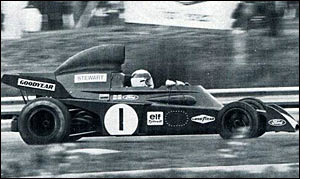 French Grand Prix
As he had hoped, Paul’s innovative track was soon adopted as the home for the French Grand Prix, with Jackie Stewart winning the inaugural event at Paul Ricard in 1971. Through the 1970s the French Grand Prix tended to alternate between Paul Ricard and other national circuits, including Dijon, but during the 1980s all but two of the Grand Prix were staged there. The last, in 1990, was won by Alain Prost for Williams. The End of an Era Although Elio de Angelis had been killed in a testing accident at Paul Ricard in 1986, and his death is often cited as a reason for the decision to move the French Grand Prix permanently to Magny Cours, the truth is probably more deeply embedded in French politics. The President of the time, François Mitterand, was a native of Nevers, just down the road from the Magny Cours circuit. He was a personal friend of Guy Ligier, owner of one of the prevalent F1 teams of the period, which was based there, and Pierre Beregovoy, French Finance Minister, was also Mayor of Nevers. Some 250 million francs were spent on upgrading Magny Cours, and from 1991 until 2008, that’s where the French Grand Prix was held. The layout at Paul Ricard was modified to address the safety issues. The Mistral straight was shortened and the first corner where de Angelis had died was re-profiled to slow it down, but denied its major role the track fell into decline. For nearly a decade the circuit was reduced to hosting club, motorcycle events and truck races. Paul Ricard himself had retired from his drinks business, handing over the reins to his son, and settled in Signes, just to the north-east of the track, where he became Mayor. He died in November 1997. A New Beginning Following Paul Ricard’s death the circuit was sold to Excelis, and the new owners embarked on a radical rebuilding programme under the guidance of Philippe Gurdjian. The intention was that Paul Ricard would become the epitome of the perfect F1 circuit. All the latest design ideas were incorporated, including a high-tech surveillance system that effectively relieves the trackside marshals of all but their emergency response duties. Thirty-eight traffic lights largely replace the old-fashioned flag waving, and a central control room (below) monitors every inch of the track using a vast array of cctv monitors. Cars are tracked electronically using on-board transponders, and timing screens can display their exact position on the circuit at any time. These transponders also trigger the warning light systems automatically if a car goes off the track. 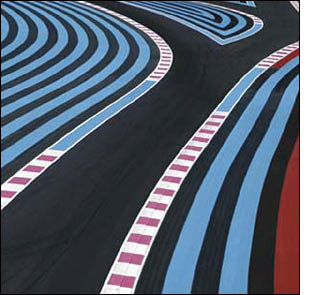 Most conspicuously, Paul Ricard does not have the usual gravel traps to collect cars that run wide, lose control, or are involved in accidents. Instead, the racing tarmac is flanked by 25 hectares of asphalt run-off carrying distinctive bands of colour in red, blue and white. Each band represents a change in abrasive qualities.
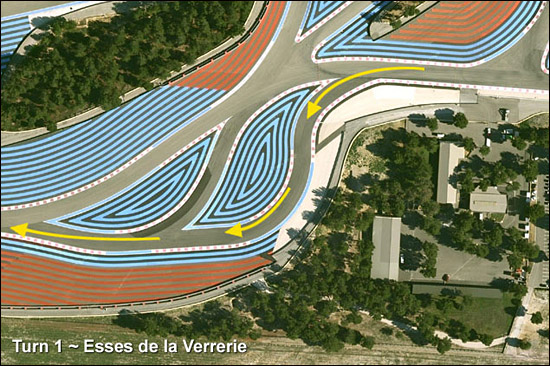
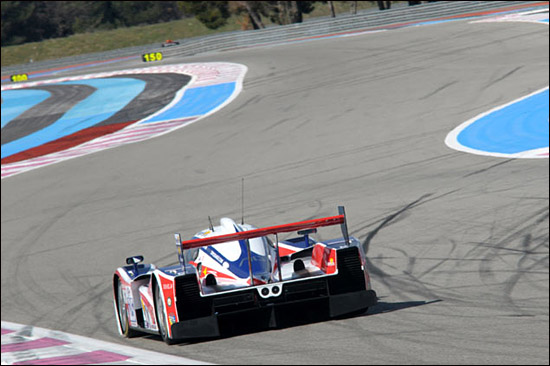
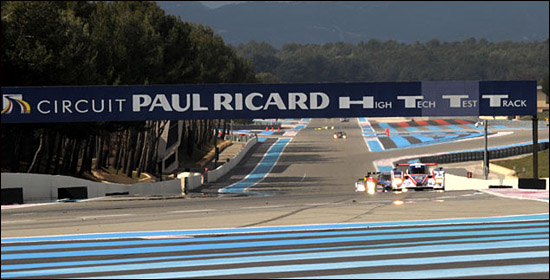
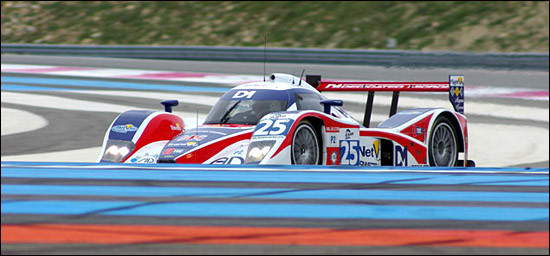
The dark asphalt is fairly conventional, but the blue bands incorporate an amalgam of tungsten to increase the “stopping power”, while the red bands are even more abrasive – so much so, that a car crossing these with its wheels locked will certainly need a new set of tyres. Elsewhere, pale-coloured run off is only mildly more abrasive than the track, and replaces the grass areas seen on regular race circuits. Right at the limit of likely excursions, the track is bordered by TecPro crushable polyethelene blocks that replace traditional tyrewalls. This type of run-off system increases safety, reduces the intervention time of the rescue teams, reduces damage to the car, and was just one of many factors that earned Paul Ricard the first FIA Institute Centre of Excellence award in 2007. Since 2009 in-season testing has been banned in Formula 1 (although is under review at the moment) and this change in the regulations meant less need for a dedicated test track like Paul Ricard. As a result, proper racing has returned to the circuit, with the FIA GT Championship being a major attraction in 2009. This season the opening round of the 2010 Le Mans Series is the big feature, and a large crowd is hoped for, although they’ll have few places to go. The spectator enclosures are restricted to the final sequence of corners and along the start straight, where a modest grandstand overlooks the pits, which all contributes to a capacity limit of just 4,000. Fortunately, it is one of the better areas to view, and with generous banking and the new Grand Prix Hall at its heart, should meet with approval. So, what is it like to race at Paul Ricard? We asked RML’s new signing for 2010, Andy Wallace, to take us on a tour of the track . . . . A Lap Of Paul Ricard With Andy Wallace We join Andy as he accelerates out of the final corner and begins a fresh lap of the circuit. All italicised sections in "inverted commas" are Andy's words. With acknowledgement to Google Maps for the overhead images of the circuit. “The lap begins as you cross the start/finish line on the Pit Straight. It’s wide, there are rows of team pit boards on the right, and you’re “plucking” gears under full acceleration on the run down to the first corner at la Verrerie.” This is the site of the original corner where de Angelis suffered his fatal accident in 1986, but the track is much changed since then. The characteristically generous Paul Ricard run-off offers plenty of forgiveness to anyone mistaking their approach – and many do. “Arriving at full revs in fifth, you line up towards the right-hand side of the track ready for the braking area. You need to watch out for cars exiting the pits, then it’s hard on the brakes and down into second gear for the left-right complex. La Verrerie is very tight but the entry is slightly faster than it looks as you approach. Around the first apex the road rises towards the second apex on the right before falling away again on the exit. It’s easy to run out of road here if you get onto the throttle too early.” The circuit plan illustrates how the organisers have more than 170 options on track layout at Paul Ricard, and Le Verrerie is one of several corners where there are numerous alternative routes. On the whole, the Le Mans Series racing line follows the longest route, around the outer limits of the track. “Next comes a short blast down towards “Chicane” (below)."  "As you approach the corner the track curves gently to the left before you brake hard again for the right, which is taken in second gear. Immediately the tight left appears, and you have to get the car slowed and down into first gear (see above). Then you momentarily go to full throttle in first before braking again for the right hander at Sainte-Beaurne.”
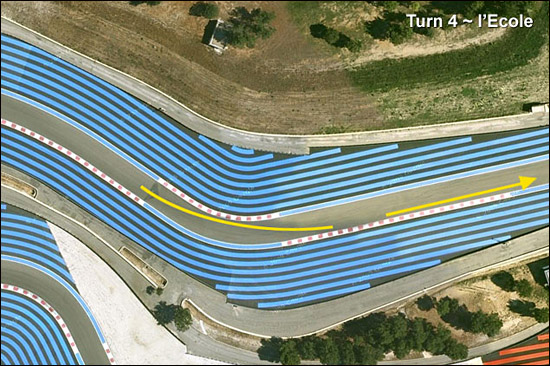
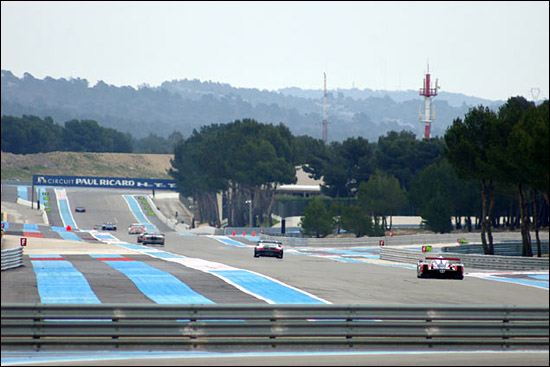
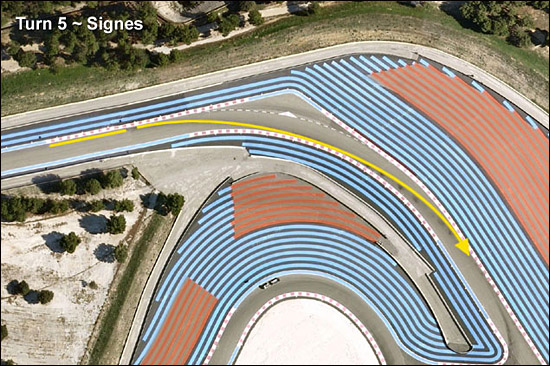
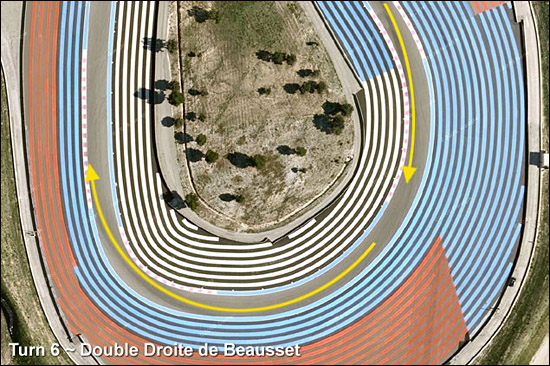
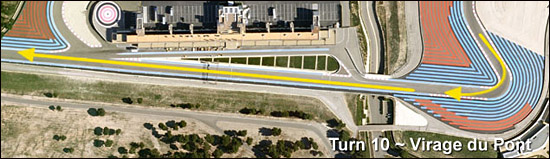
This is the farthest extent of the track, over a kilometre from the spectator enclosures, and out of sight of anyone except accredited photographers, marshals, and those watching the TV monitors. There’s a very short straight separating the two elements of the Sainte-Beaurne corner, illustrated on the left, rather like Luffield at Silverstone. A solitary tree overlooking the final element gives the drivers a reference point to work with in this important corner, since it's from here that they'll begin the slingshot that sends them out onto the Mistral. Get this right, and they can begin to unleash their car’s power for the long run up the back straight. “Back to full throttle and up through second and third gears. You have to lift slightly as the car washes wide in the long right hander of the Esses (left, top), then flat out through L’Ecole (diagram below), grabbing fourth on the exit." "Way ahead, up the long Mistral Straight, is the ultra fast Signes corner, but for now it's all about building up speed. Up through fifth to sixth gear, accelerating all the time," says Andy. It's a chance to relax, just a little, and talk to the team on the radio, receive any updates on telemetry issues from the engineers, and find out where the nearest rivals are. At 1.8 kilometres, the Mistral (above) is one of the longest straights in motorsport, and when the chicanes aren’t in use, it’s probably the only place where drivers can experience the kind of straight-line speed they’ll encounter along the Mulsanne at Le Mans. For that reason, Paul Ricard has always been a popular testing circuit for those hoping to triumph in the 24 Hours. It ends with the fast, sweeping and daunting Signes Curve, below. “Often you can feel the strong mistral winds as you momentarily relax along the straight. You have to pick a path through the worst of the bumps here too, so as not to bottom out the car too much and scrub off speed. At close to 300 km/h you arrive at Signes. Just a light dab on the brake pedal, into fifth gear, then turn-in and squeeze the throttle back down as soon as you can. The speed and the downforce are very impressive and you feel the g-force build then ebb away as you reach the exit.” The speed that the cars carry through Signes is such that the start of the double-right at De Beausset arrives in little more than the blink of an eye. The vast run-off beyond the curve is testament to the risks that drivers take as they aim to carry pace as far through the corner as they dare, and there will be few who don’t run wide here at least once during a stint. “Almost immediately you arrive at the Double Right (above). The entry is fast and the road dips away. Then it tightens quite considerably and the road rises again (below). It’s a tricky corner to get right, and in the Lola Coupé the right-hand roof pillar obscures your view of the second apex. You have to use other references to gauge where you are.” This is the point where the cars enter the field of view for those in the spectator enclosures, and it is possible to track the cars through corners 6, 7, 8 and 9, and back onto the start-finish straight. “Next comes l’Epingle (the “Pin”, Turn 7 below), a reducing radius left-hander that seems to go on forever. You can carry good speed into this second-gear corner but as it tightens, you again lose sight of the apex and have to use alternative landmarks to reach it. Back to full throttle and up through the gear around the gentle right-hand curve at Village (Turn 8 below).” It will be interesting to view the start from a vantage point somewhere near here, as the cars process through the final corners, jostling for position behind the pace car. When that dives towards the infield just beyond the final turn, that will be the signal for the pole-setter to control the final few seconds, and then unleash those tens of thousands of amassed horsepower as the race roars into life. “Turn 9, Tour (above), arrives suddenly, and you have to brake diagonally in towards the apex in order to slow the car enough to make the corner. Then a short step on the throttle in second gear takes you to the final turn, Virage du Pont (below).” “This is a very tight first gear right hander that leads you back onto the pit straight. The traction control works overtime on the exit as the tyres scrabble for grip. As you sweep across the line the lap time flashes up on the dash and you speed into another lap!” Andy has some fond memories of his laps of Paul Ricard. “I first drove at Paul Ricard in early 1988, during my audition for a place on TWR Jaguar’s Le Mans squad. It was also the first time I had driven at over 200 mph, and was a real eye opener. I got the drive, so I think I did OK!” Back in 1988 the circuit was at the height of its fame and still the venue for the French Grand Prix, but in pre-HTTT configuration. “Of course the circuit has changed a lot since then, but it still follows the same general layout. Safety has been improved beyond all recognition and the paddock facilities are truly amazing. Everything about the circuit is first class and it’s an excellent place go testing in preparation for Le Mans. I haven’t raced at Paul Ricard since my David Price Racing Harrods McLaren days in 1996, but have been lucky enough to test there on numerous occasions. I’m really looking forward to the 8 hour Le Mans Series event driving the RML AD Group Lola Coupe HPD with Tommy Erdos & Mike Newton.” RML Photos © Marcus Potts / David Stephens |