Variations On The Theme Of Winning With The Slower Car
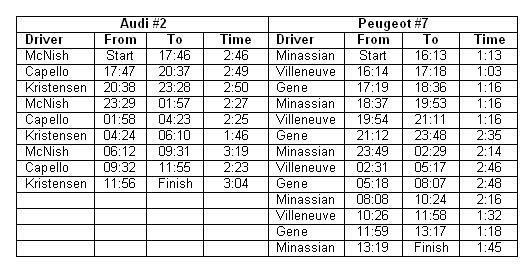
How Audi Did It Not content with accurately predicting the distance covered by the winning car to three decimal places, Paul Truswell has spent the time since Le Mans analysing the manner of Audi’s eighth win. In this first article, Paul looks at some of the key factors that determined the race’s outcome. A classic race There can be no doubt that this year’s Le Mans 24 hour race was a classic. Two major manufacturers in the LMP1 class, both with three diesel-engined V12 sportscars. One an open-top with left-hand drive, the other with a closed, coupe-style bodywork. Audi, from Germany, with a track record of seven wins in eight years and a driver line-up boasting six former winners, against Peugeot, from France, with a 100% winning record in the shorter, but still gruelling 1,000km Le Mans Series races in 2007 and 2008. In the LMP2 class, the Porsche RS Spyder, making its debut at Le Mans, brought home the (Dutch?) bacon, with the Van Merksteijn team car having a reasonably trouble-free run and finishing a very creditable tenth place overall, beating the similar car of John Nielsen’s Team Essex by 7 laps; but it was good to see a proper race between the smaller capacity prototypes, with more than 50% of the entry being classified at the finish. The heavyweights of Corvette and Aston Martin again did battle in the GT1 class, with the #63 Corvette of Magnussen, O’Connell and Fellows finishing on the same lap as the winning 009 Aston Martin of Brabham, Garcia and Turner; but although the race was close throughout, it didn’t somehow capture the attention in the way that the other classes did. In GT2, the more numerous Ferrari 430 GTs may not have qualified so well, but they showed pace and reliability that the Porsche teams envied, and the highly touted Risi line-up of Salo, Melo and Bruni earned a well-deserved victory. But it was the race for overall honours between Audi and Peugeot that most lived up to its billing, with a nail-bitingly close battle from start to finish. For those who were there, it was a race to savour, and for those who watched, listened or logged in from afar, there was always action to follow. Echoes of the (recent) past Before the race, I mentioned that there were some echoes of the 2005 race, when Audi, represented by private teams from Champion and Oreca, was severely handicapped by overly small restrictors, meaning that the unrestricted Pescarolos, conforming to the newer regulations, could run four or five seconds a lap faster. Come the finish of the race, though, it was Audi who took the chequered flag, thanks to their better reliability. During the race itself, someone remarked on the similarities to the 1995 race, when JJ Lehto simply pulverised everyone else in the rain at night, at the wheel of the Paul Lanzante-run McLaren F1-GTR. And I was also reminded of the 2004 race, when the battle between the Team Goh and Veloqx Audi R8s was similarly close, with numerous changes of lead throughout the race, and with both cars finishing on the same lap. But despite the echoes of the recent past (there’s something about Le Mans that always carries echoes of the past), this year’s race had something more to it. It was a real fight, one in which risk had to be balanced against caution, where aggression had to be balanced against discretion. Battle of the diesels In the early stages, a tremendous scrap developed between the three Peugeots and the #2 Audi, with each of them taking turns at leading at various points. Altogether the lead changed hands 21 times during the race (not counting two more changes that happened on the circuit but not across the start finish line). Funnily enough, it was the #8 and #9 Peugeots that were the quickest, taking turns at setting the fastest lap of the race, but a gearbox problem delayed the #8, losing it more than 20 minutes and #9 later lost a lap following a spin at the Ford Chicane. In the end it all boiled down to a race between the #2 Audi of Tom Kristensen, Allan McNish and Rinaldo Capello and the #7 Peugeot of Nicolas Minassian, Jacques Villeneuve and Marc Gene. I don’t believe there was any one crucial factor between these two contestants that made the difference, just small, significant aspects of the package here and there, and that is what made the contest so exciting. Firstly, the Audi pilots were able to drive some very, very long stints. I cannot find another winner of the 24 hour race who has not had to put at least one of their drivers in the car at least four times. The winning Audi crew only got in the car three times each. Look at this comparison of the stints between Audi #2 and Peugeot #7. Regardless of the fact that the Audi was regularly able to run 12 laps on a full tank of 81 litres, compared to the Peugeot’s 11 laps, the fact that the Audi drivers were regularly triple, and often quadruple stinting, gave them a small, but significant, advantage. The only glitch would appear to be that “short”, double stint of Kristensen in the early hours of Sunday morning (remember, it was raining by that stage). According to McNish, the sheer effort and concentration required (in lapping on average three seconds a lap faster than the #7 Peugeot) prompted him to call for a driver change and send Allan scurrying for his helmet and gloves. As daylight broke, however, McNish felt sufficiently comfortable during his Sunday morning stint, to ask to do another stint, only for the team to realise that it would take him perilously close to the 4 hour maximum and force him to vacate the seat. The Peugeot side of the table raises questions. Why the long stints at night, and the shorter ones in the daylight? If Gene and Villeneuve (albeit with a 2½ minute pit stop in the middle) could do quadruple stints in the rain, why not in the dry? Before I reduce the race completely to a two-car race, however, let’s take a moment to consider the rest of the diesel field: This shows the progress of each of the diesels during the race, plotted against the number of laps completed. The first dip (at 155 laps), affecting all the cars is due to the Safety Car period, and then the second downward slope is the effect of the reduced pace caused by the rain. The problems for the #8, which had gearbox problems before two hours had elapsed, and for the #1 in the later stages (clutch) are clear to see.Look more closely though, and you can see how the race turned in Audi’s favour as the lap times increased, particularly from lap 270 onwards. (For the less-numerically minded, slower laps mean increasing lap times, and are shown by the “downhill” section of the graph). Notice also how close the #2 kept to the leading Peugeots in the early stages. In fact, as this graph is based on the lap times of each car on each lap, you can also see the effect of the individual pit stops – giving the lines the “saw-tooth” effect. I am not sure that the screen resolution will allow it to be seen, but it is also possible to see the effect of the Audi’s better fuel economy and pit strategy, keeping the #2 close to the leaders. The duel between #2 and #7 Let us now examine in more detail that gap between the #2 Audi and the #7 Peugeot over the course of the race.
The idea is that this should be self-explanatory, but as I have been staring at it for hours, maybe a few extra words of clarification would be useful. First of all, this only looks at the gap between the #2 (winning) Audi and the #7 Peugeot that finished second. Of course, in the early stages, the race was being led successively by the #9 and the #8 Peugeots, which are not shown. The blue wiggly line running across the page shows the amount by which the Audi leads the Peugeot. When the line is below zero, that means that the Peugeot leads, when it is above the zero, then the Audi leads. The steps in the line are due to the different pit stop strategies of the two cars. The yellow stripe after 155 laps represents the safety car period. The blue areas on the right hand side indicate rain. Now you can make of this what you will, but the points that come through to me are: 1) From the start of the race, it takes a long time for the Peugeot to establish a lead by virtue of its speed. The Audis economy and quick pit stops keep it in contention until the 100-lap mark (six hours). 2) The gap goes up while the safety car is out, but as soon as racing resumes, it is back down to 2 mins (120 secs). 3) The gap reduces significantly just before the rain starts. This is when the Peugeot is pulled back into the garage for the radiator cleaning exercise, which loses it nearly 2 minutes. 4) As the rain continues, so the Audi is able to establish, then consolidate a lead, particularly after lap 275 (McNish versus Minassian). 5) Obviously, the track did not simply dry up from one lap to the next, so where the “blue block” finishes is a bit arbitrary. However, it is evident that the Peugeot quickly starts to close the gap. Bearing in mind that if it would not have rained again, the race would have gone on for more laps, so try extending that downward line towards the “zero” line. Go on, draw on the screen! It would almost certainly have come down to who had the fuel on board to go the distance. McNish told me after the race that the Audi was planning a splash and dash to get it to the flag. Their simulation told them that the Peugeot did not have to. It was that close. 6) In the end, the rain returns, Peugeot gets itself in a knot with the tyres, and the race goes to Audi. Who said that the Test Day didn’t teach Audi anything? They learnt exactly which tyres worked in the mixed conditions, which was a very valuable thing to know. Just ask Tom Kristensen, Allan McNish and Dindo Capello. Postscript A final word on the manner in which the race was conducted. In an era when good sportsmanship is unfashionable, it was good to see Peugeot graceful in defeat. In an echo of Jaguar in 1987, one almost expected to see “We’ll be back!” scrawled on the Peugeot pit gantry (or maybe “Nous reviendrons!”). I have it on good authority that several members of the Audi AG board were present in the Audi pit garage during the race; and it seems at least one stayed for the duration. If an indication were needed of Audi’s commitment, that was it. And I was delighted to hear that the Peugeot mechanics (not the top brass, the mechanics) were invited to the Audi post-race celebration. As they entered, all conversation stopped and spontaneous applause broke out. Not big-headed or boastful, just one group of folk expressing empathy for another, both of whom worked their socks off in an effort to win the biggest test of endurance in motorsport. No one could have designed a better advertisement for international motorsport at a time when other branches of the sport seem intent on self-destruction.
Next week, Trussers has promised an in-depth look at individual driver performances and an answer to the question "Is JV Le Mans winning material?"
|