Oschersleben Winners Lose Appeal
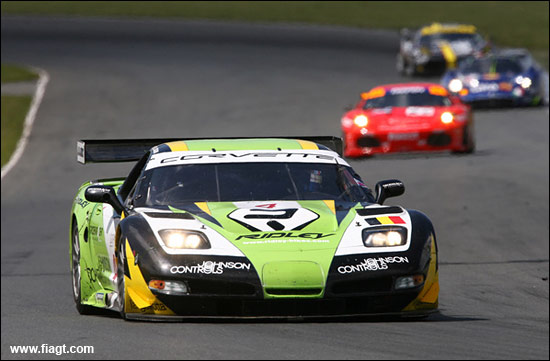
Kumpen And Longin Are Most Unhappy The FIA has yet to publicly announce the result of PK Carsport’s exclusion from the results of the Oschersleben FIA GT event, but the team has been informed that it has lost its appeal – despite evidence being submitted to indicate that the original result should stand. PK Carsport has indicated that the matter will now be taken to the civil law courts. Anthony Kumpen and Bert Longin were first across the line at Oschersleben on July 8, winning the two hour race comfortably in the PK Carsport Corvette C5-R. Several hours later, they were disqualified for non-conformity of their fuel cell (fuel system) which apparently was deemed to have a capacity of more than 100 litres. Four documents were produced by the team to support its claim that the system did conform to the regulations. All four have been made available to the media. The statement today (July 25) by Anthony Kumpen and Bert Longin makes their feelings absolutely clear. “This is unbelievable, outrageous and scandalous. We are quite simply being scoffed at by the FIA. We had a very strong defence but these were not taken into account. We stand firm, we are not fraudsters but we are disadvantaged through the fact that we are a small Belgian team. There’s obviously far more lurking behind this decision. It is a downright disgrace.” The documents provided by the team to support its appeal were as follows. - A document issued by SGS, a Belgian organisation officially recognised by the FIA regarding all possible problems or conflicts concerning fuels, oils etc.
- An email issued by Total Elf, the official supplier of fuel in the FIA championship.
- A document emanating from the University of Leuven.
- A document issued by Pratt & Miller who confirm that the fuel cell is still the same original cell, referring to the cell’s original numbers. This cell had been approved by the FIA at various previous measuring sessions, and there had never been a problem. Kumpen and Longin explain their case as follows: “At the time of the measurement the fuel temperature was 34 degrees centigrade, whereas the measuring equipment used is set at 20 degrees centigrade. As such the fuel was 14 degrees too warm. Fuel expands as it warms up. Three independent bodies, all references in their own field and of which one is even recognised by the FIA, proved that we were in our right. Each one provided the necessary documents as proof but nothing was done with these. Even Pratt & Miller, the car’s builder offered up the necessary proof. Pratt & Miller would never put their reputation on the line merely to oblige us. These are correct people and have issued the necessary proof. But the FIA didn’t do anything with these proofs.” “We could even have claimed that there were procedure errors, but we didn’t want to go down that route. We contacted our legal advisor. We’re not going to give in to this decision and are taking our case to the civil law court. This can and will lead to unexpected consequences. A competitor wins? Ok, a complaint is lodged. In fact we’re only talking about a small insignificant team. The proofs? Oh, we just wipe those off the table. After all we are the strongest, let the weaker ones fight it out amongst themselves…. ” “This is a corrupt decision made by people who want to destroy motor sport. In our eyes the FIA has no value any more. They are not objective. This is a very sad day for the Belgian motor sport and for the sport as a whole.” The reference to “procedure errors” refers to the team’s information that the decision of the Stewards of the Meeting was taken at 20h05 on July 8 and notified to the competitor at 20h33. The document of the technical delegate (technical report n°04) was only been presented to the Stewards of the Meeting at 20h40. The results of the investigation by the SGS organisation included the results below, which clearly suggest that 100 litres of fuel at this density (other densities were investigated too), at 15 degrees Celsius would expand to 102.264 litres at 34 degrees. Density at 15°C [kg/L] 0,7542
Weight of 100L of fuel at this density [kg] 75,42
Density at 34°C [kg] 0,7375
Fuel volume becomes [L]: 102,264 The measured volume of the fuel system of the Corvette post-race on July 8 (at 34 degrees) was 101.26 litres. |