There should be a flash banner here. There are 2 main reasons why you may not be able to see it:
You do not have the required version of Flash MX installed (v8.0+) in your browser
JavaScript is disabled in your browser
Sachsenring Observations A Hungarian View Of East Germany
Sports car racing purists have no end of arguments as to why the FIA GT1 World Championship should not lay claim to any of the words in its title. Whatever the merits of the discourse pro and con, we have as the titular monarch of sports car series these one-hour single-class sprints. Some see lemons, others see lemonade.
The races themselves range from the processional to the chaotic, with very little in between. Indeed, most of the sprints feature both characteristics within the short hour. Witness Saturday’s qualifying race, which started with “only” a two-car kerfuffle, while many teams expected three or four to be involved. One can ill afford to lose more from a 17-car starting field.
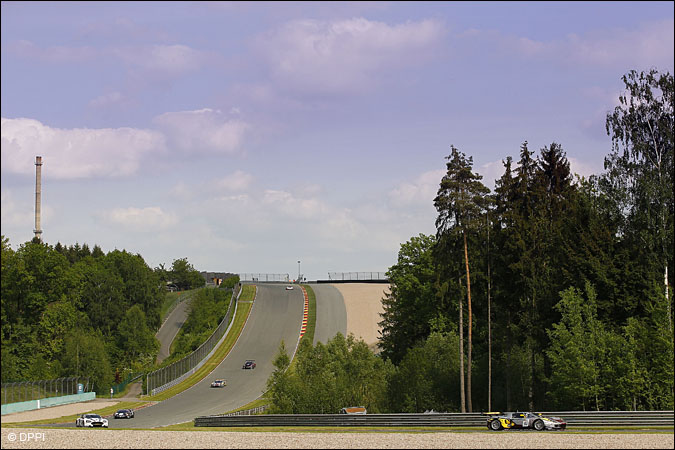
The cars are throaty dinosaurs and thus garner their own unique interest. It has all the feel of a “transition year”—a great euphemism for struggling series the world over. On the other hand, it is noteworthy that new venues bring fresh perspectives. This is the first visit of the series – or, for that matter, any world class level automobile series – to this eastern German circuit. The Sachsenring is known primarily as a motorbike track and certainly has those characteristics—tight turns and lots of elevation changes. Darren Turner put it best, “it is really two tracks, the first up to Turn 6 is tight and the rest is a fast roller-coaster ride.”
It is very scenic and historic. The old Sachsenring was a very long public road circuit around the neighboring farms that dates to 1927. This lends an atmosphere not unlike the Czech circuit of Brno—wooded, hilly, and a modern rump of an old classic.
The differences are that Sachsenring is a bit more compact, with some agricultural and light industry park surroundings; and while Brno is directly adjacent to its namesake city, Sachsenring is at the edge of the small village of Hohenstein-Ernsthhall, which is in turn about 15 kilometers west of the regional center of Karl Marx Stadt… er, I mean Chemnitz.
Yes, we are in the old DDR, which over two decades after the fall of the Wall is still a “special” place. It’s not quite the paranoid backwater it once was, but the difference might be described as: if western Germany is like New York State, Ost-Deutschland has elements of Alabama and Mississippi. Most vestiges of the Communist past have been eradicated in favor of full-bore German capitalism, but there still is a huge bust of Marx’s head prominent in central Chemnitz. At about 20 meters in diameter it’s simply too big to blow up. It has been left to tarnish and age while the square around is filled with fairs, markets, and this weekend even some kind of family 10k run.
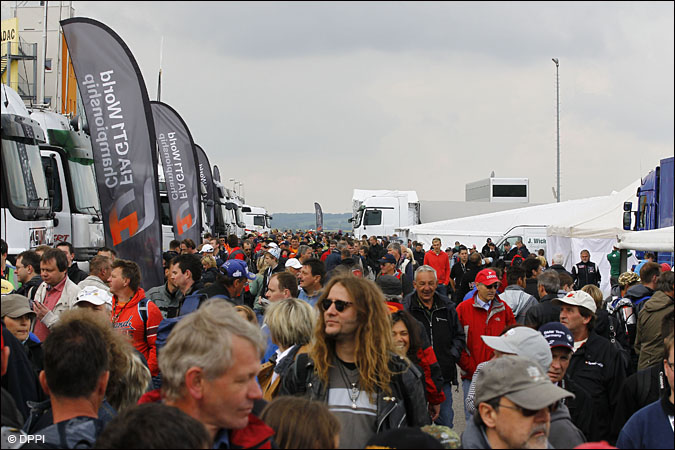
Despite a brief dense shower on Sunday morning, the weather was of a pleasant spring variety, and hadn’t kept the place from filling up nicely. There were perhaps 25,000 spectators in the ample grandstands (announced at only moderately-inflated levels to 45k for the weekend).
While the Moto GP here attracts many times that number, the interest in this rare appearance of major car racing here is nice to see.
Probably many were there for the ADAC GT Masters, Germany’s national GT3 championship. As with all GT3 series, it has the most diverse entry in terms of marques and driver skills of any sports car league. Saturday’s inverted gull wing Mercedes showed just how thrilling it can be. After the tap from the Lamborghini, the SLS became airborne by a good meter or so, thus immediately inducting Robert Renauer into the official Flying Mercedes Club—Peter Dumbreck, president.
The start of the “real” GT1 race on Sunday afternoon came to a circuit under partly cloudy skies. It was windy and the threat of further rain remained. The grass and runoff areas were soggy.
Maxime Martin took the start in the qualifying-race-winning #41 Marc VDS Ford GT clone, with young phenom Stef Dusseldorp alongside in the #3 Hexis Aston. As Marcel ten Caat noted at the time, these two cars along with the other Hexis entry, were under a bit of investigation following the qualifying race but were deemed not guilty as charged and the provisional results stood.
What was that about predicting a four-car off at the start? Well, those soothsayers had their wish for the championship round. Dusseldorp bumped Martin going into Turn 1. The Aston went the furthest astray but recovered and rejoined the field from the rear. The Ford seemed relatively undamaged but lost several spots; but the accordion effect caught out the Lambos of Swiss Racing Team. Karl Wendlinger strode off across the gravel to one side while Max Nilsson stopped askew in the center of the racing surface - necessitating an eight minute, three lap Safety Car intervention.
Vanina Ickx unfortunately accepted an invitation to the same party and the #9 Belgian Ford’s wheel was irreparably damaged, though she staggered back to the pits.
Stefan Mücke (#8 Young Driver Aston) took what seemed to be a strong lead once the field was released, but Christian Hohenadel soon caught up in the #4 Hexis DB9. A spot of rain coincided with the restart but it came to nothing and soon dissipated.
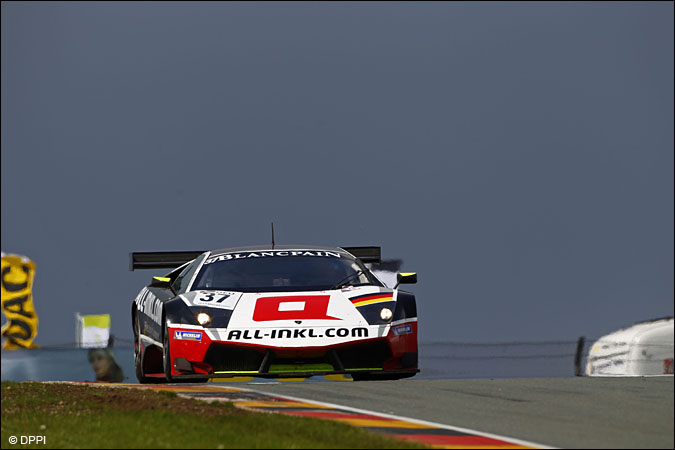
The first lap hit did turn out to be fatal for #41’s chances, though, as the pole-sitting car of Maxime Martin started to slow with a smoky right-rear wheel and was eventually retired. Meanwhile, the battle for the front heated up as Hohenadel first caught up with Mücke and then bumped into the lead. Dominik Schwager made a more polite move, putting the healthiest and fastest Murcielago into second place.
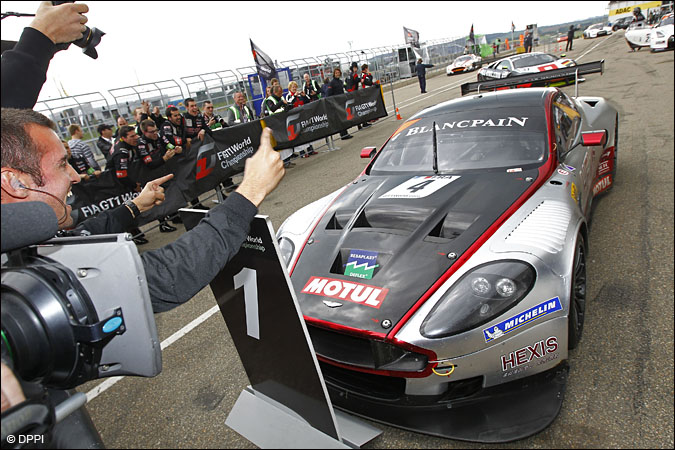
Markus Winkelhock (#38 All-Inkl Lambo) was among the last to pit, thus inheriting the lead during the pit window. It was more or less game, set and match in the pits, as the Hexis team demonstrated—as they had previously in the year – superior crew-work which projected Andrea Piccini into the lead once he took over from Hohenadel.
Meanwhile, any hope of a return to the front by the #38 ended when it pitted and was serviced in a far-less-stellar manner. When Winkelhock stopped and Basseng took over, the crew dutifully replaced all the Michelins but forgot the minor detail of tightening the right rear lug nut.
Basseng did lose the nut on the first downhill but thankfully never had an opportunity to lose the wheel as he was tapped off course by the approaching #3 Hexis Aston Martin, now with Clivio Piccione driving. Meanwhile, Andrea Piccini strode into a four/five second lead that came down a bit only very briefly when second place Nicky Pastorelli put in a couple of fast laps.
Thereafter we were treated to the scintillating view of Marc Hennerici (#40 VDS Ford) chasing down and passing Michael Krumm (#23 JR Nissan) for eighth place. Finally there was a slight bit of sumo wrestling between the Nissans of Enrique Bernoldi (#20) and Jamie Campbell-Walter (#21).
Chaos or procession? Take your pick, but you can’t have both.