
|
Le Mans 24 Hours -
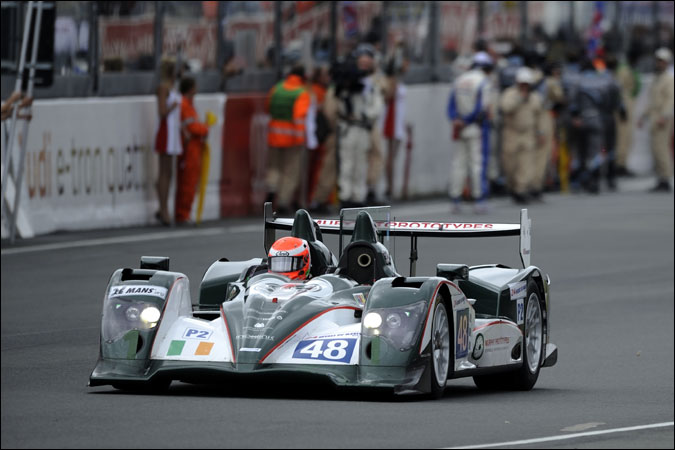
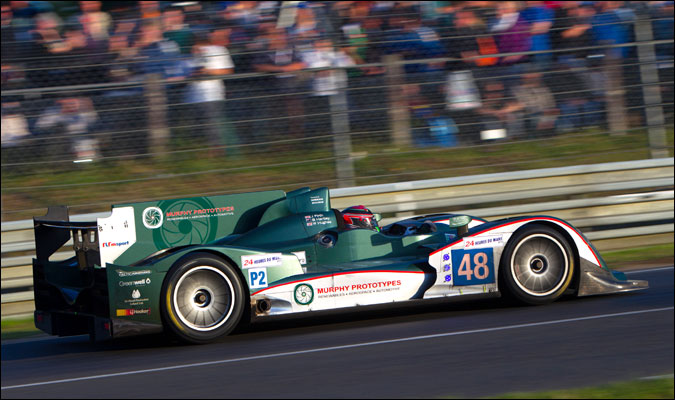
Murphy Prototypes Race Report How will we remember the 80th edition of the Le Mans 24 Hours? Another clean sweep by Audi? The first outright victory by a hybrid powered car? Those facts will be duly noted in the record books, of course. An unexpectedly impressive showing by the Toyota TS030? The car certainly took the race to Audi when few would have predicted such a competitive package, straight out of the box. The rain that never came? Possibly, and anyone who recalls the conditions during Saturday morning warm-up may still find it hard to believe that we had a dry race. For me, though, there are two features that really stand out. One was being privileged enough to witness the Le Mans debut of a team with a fantastic attitude towards motor racing, and the second was realising that even the Luck of the Irish has its limitations. By the time the Le Mans paddock started to fill with trucks Murphy Prototypes had already established something of a reputation. The new name came thanks to the backing of the Irish “green energy” entrepreneur Greg Murphy, but merely served to mask a well-established team under the guidance of RLR M-sport’s Nick Reynolds. The driver choice of Warren Hughes, Jody Firth and Brendon Hartley had also stirred some interest, with the mix of experience and talent earning the trio the billing of “one of the quickest line-ups in LMP2” and, much to Warren’s discomfort, raised expectation of what the #48 Oreca might achieve. Being among the class favourites was not on his checklist, but by the time the team lined up on the grid for the race on Saturday, the box was appropriately ticked.
The team’s ethos had always been “for the long game”, and Greg had repeatedly emphasised that there would be no heroics in qualifying. All the crew’s efforts went into ensuring that the car was perfectly prepared for the race itself, and judging by the feedback received from the drivers, that’s exactly what Reynolds and his engineers achieved. “We’re as prepared as we ever can be,” said Murphy after warm-up. “The car has been fitted with a new engine, gearbox and suspension – you name it, it’s been fitted. The guys have double-checked every nut and bolt, and it was all bedded-in during warm-up. There’s nothing more we can do.” The car had run in race trim throughout practice and qualifying, and sixth on the grid amid a field of 20 was just fine. It was high enough to reaffirm the car’s potential without drawing more attention on Warren Hughes as he prepared for the race start. “I’m pleased that Warren is starting,” admitted Jody Firth. “He’s a safe pair of hands and he won’t be tempted into anything rash. There shouldn’t be any dramas, but if there are, I know he’ll cope. Now I’m just looking forward to getting in the car and going racing. The waiting is the hardest part, but knowing that our car feels so good, wet or dry, helps enormously. We know we’ve got an excellent race set-up, and it suits us all. We’re well matched on pace – and it’s a great pace too - and provided we can keep out of trouble and don’t have too many problems, I think we have an excellent chance.”
Brendon Hartley, making his Le Mans debut, was caught by the sense of anticipation. “I just feel so enormously privileged to be here,” he said, gazing towards the packed grandstands. “The passion and enthusiasm of the people of Le Mans is just amazing. I’m not particularly nervous yet, but I am feeling very excited and, dare I say it, quite confident. The conditions in warm-up this morning were the worst I think I’ve ever seen on a race track, but the car still felt so good. It’s incredible what the team’s achieved. I have full trust in my team mates. I’m not worried about either of them making a mistake – they won’t do it – but I do feel the added pressure of being the new guy in the team. I don’t want to let them down.” On the basis of his performance in Spa, and the discipline he’d displayed at the test weekend and during qualifying, that seemed unlikely. However, he had several hours to steel himself for the challenge, since Brendon wouldn’t be joining the race until Warren and Jody had each completed their opening stints.
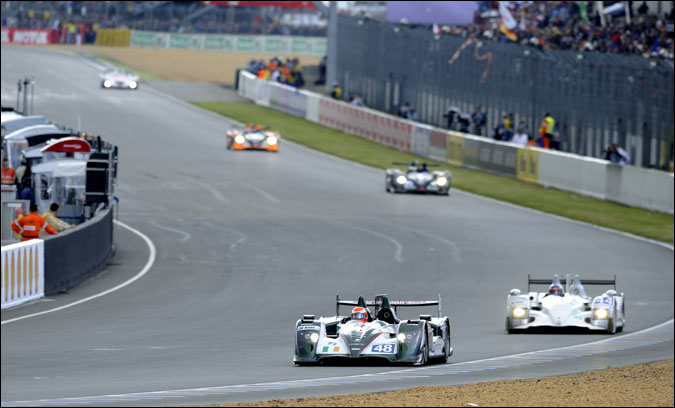
Murphy’s Race Warren Hughes was lined up 6th in LMP2, technically nineteenth overall, but effectively on the ninth row as only 54 cars would be moving away from the starting grid. Two LMP1 cars – the #21 Strakka Racing HPD and the #16 Pescarolo - would be joining from the pitlane and leaving gaps in the ranks ahead of Warren. To the sound of pounding timpani and the stirring chords of Also sprach Zarathustra (better known as the theme to 2001: A Space Odyssey) the pace car heralded the arrival of the leaders at the Ford Chicane, bunched up and controlled by André Lotterer in the pole-setting Audi #1. He held them on a tight leash as they jostled through the first two elements of the complex, and then floored the throttle through the final twists to leave the rest standing. The leaders were strung out along the pit straight and sweeping through the first right-hander into Dunlop even before Warren and the P2 front-runners had crossed the start line. It was a bit of a scrum, and Warren was squeezed into a corner as the group hit the brakes for Dunlop. “I got boxed in completely, and Maxime (Martin in the #35 Oak) got a jump on me,” admitted Warren. “He dived through, so I lost one place, but I wanted to be sure that everything was up to temperature before I started pushing. I was confident I had the pace and plenty of time to get back at him, but the track felt surprisingly green. There were still some spots of rain falling, and the line wasn’t totally dry, so there were quite a few areas where it still felt very slippy.” Once under the bridge and on the run down through the Esses, Warren latched onto the back of the pink and black Morgan, determined not to let Martin get away. In his rear-view mirrors, Tom Kimber-Smith was doing exactly the same in the Starworks HPD #44. The trio would complete the lap in sixth, seventh and eighth respectively – and remain strung together like beads on a necklace for the next hour!
“Once I’d decided to go, I locked onto the back of Maxime, and I was stuck there almost to the end of my triple stint. It was very frustrating! Unless he made a mistake, I knew it was going to be almost impossible to pass.” Over the course of a lap the three cars were fairly evenly matched, but it was soon clear that Martin was inherently the slowest. “I definitely had the advantage through the slow-speed stuff,” insisted Hughes, “and he was holding me back there, but in a straight line I couldn’t find a way by.” With his concentration on Maxime ahead of him, it was easy for Warren to overlook the threat from behind, and as he looked for his own opportunity to get by the Oak, Tom Kimber-Smith was seeking a similar opening. With half an hour of the race completed, he found it, and the Starworks HPD was through into seventh.
It was merely a change in order, because the three remained inseparable. As a triumvirate, they all overtook Nelcon Panciatici in the #26 Signatech Nissan, who’d dropped four places since the start. With his tyres starting to grip significantly better, Warren upped his pace, posting a new fastest lap and then carrying that through to a neat overtake on Kimber-Smith. The status quo had been restored, at least until the first round of pitstops. Suspecting an issue with one of the tyres, the team gave Warren a replacement, and he resumed in fifth. The fresh rubber seemed to make a difference, and the #48 closed to within half a second of Maxime, but Warren still had that Starworks HPD tight on his tail. As the race entered its second hour, the two cars swapped places again . . . and again . . . and again. “Tom and I chopped and changed several times,” said Warren. “It was fine – just good clean racing and treating each other with respect. Neither of us was out to take risks or jeopardise anything, We just had a very similar pace.”
At the next round of pitstops, a relatively slow visit for the #35 Oak coincided with a rapid turn-around for Starworks, and Kimber-Smith rejoin ahead of Martin. “Tom managed to get the jump on the Oak, and he was away,” observed Hughes, who was not so fortunate. Olivier Pla was leading from Ayari second, Kimber-Smith third, and Martin fourth. Once again, the #35 Oak Morgan became the cork in the bottleneck, not only holding back Hughes, but also allowing Matthias Beche in the #46 Thiriet by TDS Oreca to close the gap; all three running nose-to-tail. Warren Hughes had been staring at the rear-end of Maxime Martin’s Oak for the best part of an hour, and he would continue to do so for the remainder of his triple stint. It’s a distinctive colour scheme, admittedly, and probably vibrant enough to give some people a migraine, but not one any driver needs to see for two unremitting hours! After narrowly missing being taken out by Ludovic Badey in the #28 Gulf Racing Lola, Hughes was probably relieved to hand over driving duties to Jody Firth at just after five o’clock. “The track felt quite strange in that first triple – very different from the way it had been during practice and qualifying,” suggested Hughes. “It tended to make the car feel very over-steery through the high-speed corners, which was something new to cope with.”
Jody Firth, the team’s “gentleman driver”, picked up the theme and continued to fight his way through what was a very close-knit group. Kimber-Smith, heading for a quadruple first stint, had made it through to second, but Firth’s take-over from Hughes meant a lengthier pitstop, and a drop to sixth. He emerged behind Bas Leinders in the #35 Oak, obviously on a similar strategy. However, a swift mid-stint pitstop eased Firth through to fourth, and some consistently fast lapping, including a new fastest time for the #48, ensured that he not only held on to that for the remainder of his turn, but also passed Ryan Dalziel for third place after Kimber-Smith relinquished the Starworks cockpit.
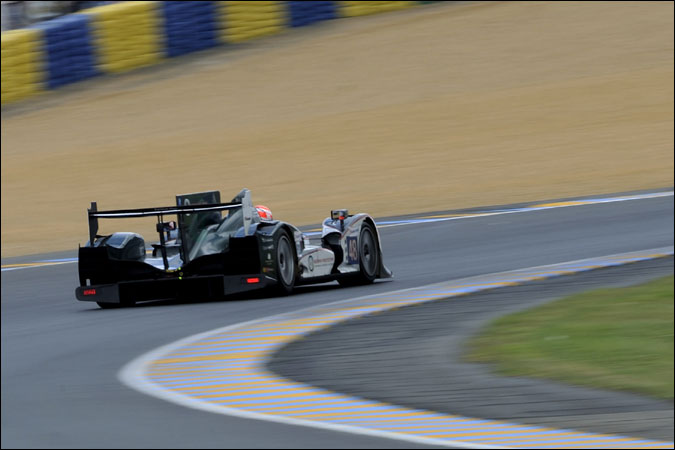
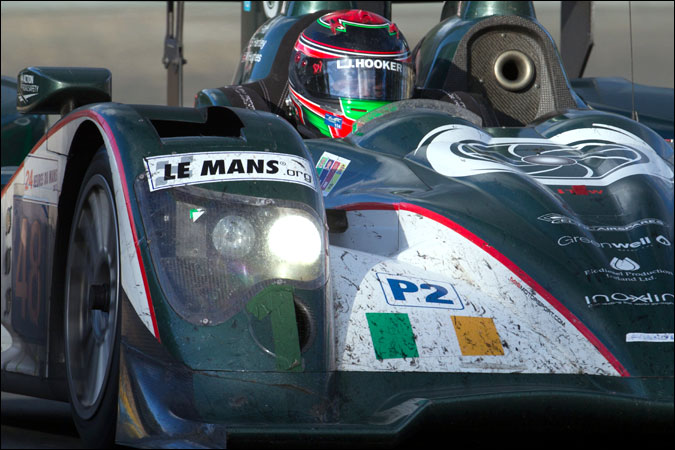
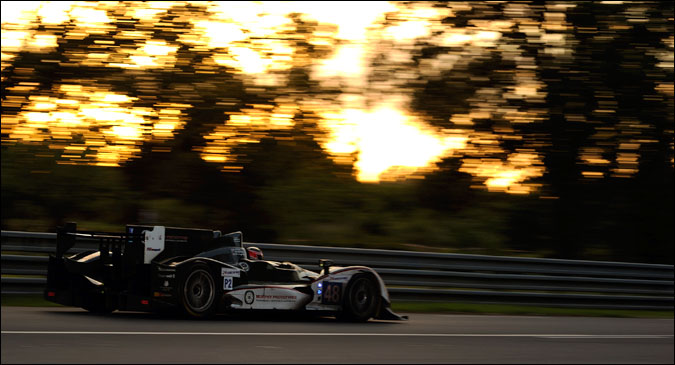
The radio link between Firth and the team had gone dead half-way through his triple stint, and Brendon Hartley had been on standby for some time before he actually got the chance to take over. It was quarter after seven, and it would be Brendon’s first experience of racing at Le Mans. Ryan Dalziel had moved back into third, but the gap wasn’t much. Just two laps into his first racing stint, and Hartley was already setting new fastest laps for the Murphy Oreca and closing on Dalziel. It was just a matter of time before he took third. On lap 55, the 22-year-old was through. “After two or three laps I was really comfortable and felt right at home in the car; everything clicked. I was passing other LMP2 cars and we had great pace,” said Hartley.
Any immediate hopes of catching David Heinemeier Hansson in the #35 Oak for second were dashed, as were those of Anthony Davidson, when the #8 Toyota was clipped into a horrifying flip at Mulsanne Corner. Hartley spent over an hour behind the safety car, but he was just biding his time. Bunched together even more closely, he pounced on Heinemeier Hansson at the restart, and moved cleanly through to second in class, 9th overall. A few minutes later Hartley was on the scene, and probably a witness, when the surviving #7 Toyota was involved in another on-track incident. This time the boot was on the other foot. Dicing through the Porsche Curves, Hartley had just passed Toshi Motoyama in the black DeltaWing when Kazuki Nakajima came through to lap them both. Somehow, the Toyota driver failed to see the squat nose of the DeltaWing, and simply cut back in front far too early. Nudged off line, Motoyama had nowhere to go but straight into the concrete wall.
Hartley pressed on, but was unable to extend his advantage over Heinemeier Hansson enough to prevent the Oak retaking the place during his next pitstop, but a 3:41.535 from the youngster soon afterwards confirmed that he was determined to make it stick next time. When the Oak did finally pit, Hartley eased through to inherit the class lead – the first time for the #48 Murphy prototypes Oreca since the race began. It was almost exactly ten o’clock.
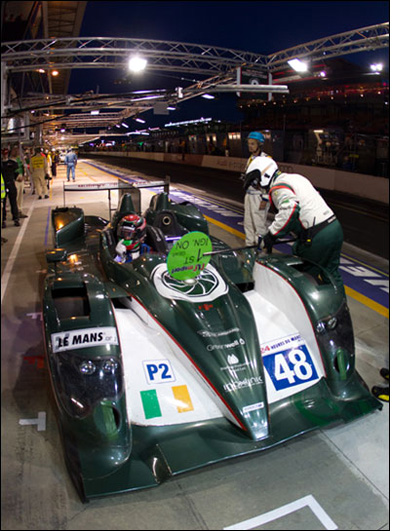
Not only was Hartley leading LMP2, but he was running an impressive 7th overall. He was also pulling away from the #24 Oak, at that time running second with Jacques Nicolet at the wheel – although Nicolet was in turn losing ground to Martin, back in the #35, third and closing. The lead changed again under the next series of pitstops, but Hartley’s pace was steadily establishing a genuine advantage. When Warren Hughes climbed back into the #48 some forty minutes later, there was enough of a gap to ensure that he retained the top slot. Through until Midnight, Hughes held the class lead. The margin oscillated between forty seconds and just ten – thanks to some quick laps from Olivier Pla, back in the #24 – but essentially, Murphy Prototypes were leading LMP2 at Le Mans. “The track was definitely coming to us as the race developed,” said Hughes. “Jody and Brendon both had good runs, and by the time I got in again, the car felt really good – very easy to drive, with lots of grip, and great balance - and we were able to set forty-ones fairly easily, lap after lap. Olivier Pla had similar pace to us at that stage, but I was leading, and the race was coming our way.” At quarter past, that prediction hit its first set-back. “It was two laps before the end of my stint,” explained Hughes “I sensed a vibration from the back of the car. There was so much gravel and debris on the track by then, it was easy to pick up rubbish on the tyres, so it was hard to tell what was causing it, but the vibration suddenly got a lot worse. I got as far as Arnage, and then the tyre let go.” The Dunlop disintegrated in a matter of moments, throwing shreds of rubber up through the bodywork, and flailing wildly around the rim. With a third of the track to cover, Hughes eased back as best he could, and made his way gingerly back to the pitlane. That slow return, combined with an extra nine minutes in the garage to effect the repairs, cost the team roughly four laps, and when Jody Firth returned to the track, the #48 had dropped to 9th in class, 16th overall.
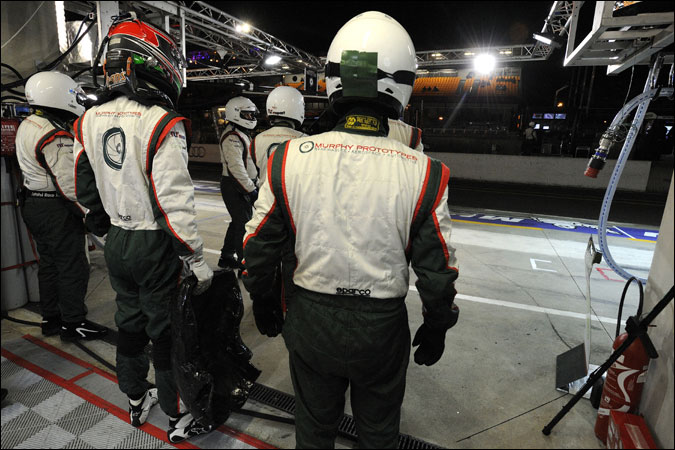
What was impressive about the pitstop was the way the new panel fitted the car so perfectly. It was a brand new rear valence, straight out of the Oreca spares truck, and had never been offered up to the car before. It fitted first time. Quality control in evidence! With that drama overcome the team’s race returned to plan. Firth completed his next scheduled pitstop at just after one in the morning, and within half an hour, he was running 7th, 14th overall. An hour later, and nearing the end of his second set of stints, Firth passed Alex Sims in the #30 Status GP Lola for a 6th.
Slicing through the Porsche Curves, building up the lateral G, and closing on Pierre Thiriet in the #46, Hartley detected a brief sensation of movement from the back of the car. He’d just come through the final kink in the Curves and was gunning for the Ford Chicane. As he passed the entry to the pitlane, and began to brake and turn in for the left-hander, the rear of the car suddenly snapped away. Pitched into a spin, the Oreca slewed sideways, and buried itself in the gravel. “I’d felt a slight vibration coming out of the Porsche Curves, and then the car suddenly gave way,” said Hartley afterwards. “Part of the rear suspension had broken. I thought I might be able to get the car back to the pits, but I couldn’t get the car to move. It was simply undriveable. One of the rear wheels just kept spinning round.” The marshals hauled the car out of harms way. After initially getting out of the car and starting to walk away, Hartley was urged to go back to the stricken Oreca and try to get it going again. With words of advice from trackside, he strived to find a solution, and managed to get the engine re-started, but the broken transmission to the left rear wheel prevented any forward movement. It was race over for Murphy Prototypes. At 05:48 on Sunday morning, the entry on the timing screens for the #48 Murphy Oreca faded away to grey. The subtle change confirmed the 14th official retirement on 196 laps. There was a sense of disbelief in the team garage, with crew members walking around, seemingly dazed. “The luck of the Irish, eh?” managed Greg Murphy, a smile on his face, but a twinkle in his eye that wasn’t from amusement. “Come on, if Le Mans was easy, we wouldn’t want to do it now, would we? At least we led the race for a while, and I feel enormously proud that we’ve done that much. What’s more, this has saved me a fortune in engine hours and tyres!” Even in the face of such massive disappointment, it’s impossible to take the joker out of Greg Murphy. “We’ll be back, don’t you worry. Everyone in the team worked their socks off today. I stand by what I’ve said before that I wouldn’t swap my drivers for anyone else on the grid. We are who we are and we won’t give up. Watch this space.”
At which point, Brendon Hartley walked back into the garage, head down, his shoulders slumped. Murphy strode over and swamped his driver in a massive bear-hug. “It’s OK Brendon – it’s not as if anyone died. It’s a motor race. These things happen!” A hesitant smile broke across the young man’s face, almost hidden beneath a wayward thatch of blond hair. He was evidently not convinced, but it was the kind of reassurance he needed. With Brendon’s return to the fold, the reality finally sunk in, and the bold green and white #48 wasn’t about to come burbling down the pitlane to the garage. It really was all over. A spontaneous round of applause broke out around the garage, muted at first, but gathering in strength. “Well done guys,” said Nick Reynolds. “Well done.” “Despite not finishing, I have to say that this has been an amazing effort from a team that’s never been to Le Mans before – totally fabulous,” said Warren Hughes. “I’ve been very impressed by Brendon and Jody. They drove so well, and working with them, and everyone else in the team, has had a huge impact on me. Everyone put their heart and soul into this. But it just shows you what a difficult race this is. Once we had the lead, some people thought we had it covered, but we didn’t. For a little while we were there, at the top of the pile, but the race won again this time.” “I’m naturally very disappointed that we could not finish the race, but the team did nothing wrong," insisted Jody Firth. “It’s just one of those things. It’s endurance racing. We had the pace and we held on to the lead for a long time, and that’s a very satisfying to achieve in our first Le Mans 24 Hours. We’ve shown that we can compete with best.”
Murphy Prototypes is a new team - young in almost every sense – and brimming with enthusiasm and talent. They’re now building experience into that equation as well, firming up the foundations set in place by the likes of Warren Hughes and Nick Reynolds. That strength makes them genuine contenders in what is currently the toughest branch of motorsport. Rest assured, when the team arrives at Donington Park in a fortnight’s time they’ll have drawn all the positives out of their hours at Le Mans, and they’ll be as determined as ever to get that Irish tricolour back onto the podium. The luck may have run out at Le Mans, but the leprechaun says there’s gold at the end of that rainbow. MP |




 Brendon
Hartley returned to the cockpit for the run through to dawn, when Hughes would
take over once again . . . but that driver-change never came. Brendon had been
setting a blistering pace, as usual, and had even established a new fastest lap
for the #48 Murphy of 3:40.770. He’d also moved up to 5th in P2, 13th overall,
when things went horribly wrong.

