How Le Mans Was Won
The Drivers In the second of his analysis pieces (the first being here), Paul Truswell looks at the relative performance of the drivers at this year’s Le Mans 24 Hours, and invites the reader to draw their own conclusions. Not long after this year’s 24-hour race, I had a phone call from Allan McNish. I should perhaps point out that this was not exactly out of the blue – I had sent some questions to the Audi Press Office, and was advised that the best way to get some answers was to speak to Allan himself. After a couple of misses and messages left, we finally got together for a chat, as Allan was on his way ‘home’ to Dumfries to work with some local school’s auto-engineering project. Fine work for a Le Mans winner. Anyway, one of our topics of conversation was the relative performance of the three winning Audi drivers. I put it to Allan that all three of the drivers, Dindo Capello, Tom Kristensen (“Tommy-boy”, as Allan kept calling him) and Allan were very closely matched, and unlike last year, it wasn’t possible to separate one of them out as clearly the quickest driver. “We’re like three sides of a triangle,” he said, “Each of us supports the other. Tommy-boy and I have a similar attitude to winning, and Dindo is a great calming influence on us both. But Tom was very strong this year – don’t forget that last year, Le Mans was his first race since the accident.” He was referring to Kristensen’s very heavy shunt in the DTM race at Hockenheim that kept him out of racing for nearly two months. I also put to McNish the fact that not his car, but the #3 Audi, with Alexandre Prémat at the wheel, turned the fastest Audi lap of the race. “It’s a combination of things”, the Scot replied, “having the traffic conditions in your favour, the track dry, and feeling confident in the car.” Did Prémat, having missed out on a drive in last year’s race due to Mike Rockenfeller’s accident before Alex could get in the car, have something to prove? I asked. “He’s certainly very quick”, said McNish. “I think Lucas is very well-rounded, though. I’ve worked with him a lot, and he thinks a great deal about his driving, the car, and what needs to be done.” Also, on the subject of lap times, I reminded Allan that the #2 car’s quickest lap of the entire week was in Saturday morning’s warm up. “Same thing as I already told you,” came the answer, “the track was clear, the tyres were good and it was just possible to go for it.” So it was surprising, wasn’t it, that the car didn’t go quicker still in the race? Did they make any changes to it, so that it would be easier to drive in the rain that would surely come in the race? “We made no changes to the car whatsoever. We left the set-up, everything, exactly the same from the warm-up, right through the race. We did nothing to the car in the race, apart from fuel and tyres. We added a litre of oil just before 8 o’clock in the morning, but that was it.” “As for why we didn’t go quicker in the race, the circumstances never combined to allow it. If it had stayed dry for my stint on Sunday morning (from 06:12 to 09:31 - PT) when the air was cool and the track was less crowded, I am sure I would have gone quicker than in the warm up. But it obviously wasn’t possible.” Those are the thoughts of Allan McNish, then. But what about the objective view? What about the data? Fast Laps
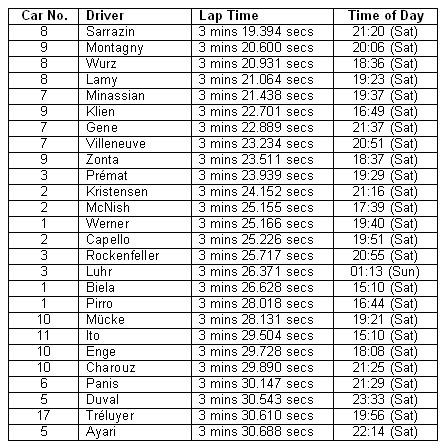
At the risk of upsetting the sometimes-fragile egos that inhabit the top cars, I looked at some fast laps. A total of twenty-six drivers lapped below 3 mins 31 secs during the race. Their best laps are shown in the table below. I originally intended to draw the cut-off at 3 mins 30 secs, but the additional petrol-engined LMP1 cars allowed in by the one second extension made it worth doing. I had to stop somewhere though. And as Allan McNish implied, the list would probably be longer, had the race remained dry, but it is always interesting to compare cars, drivers or whatever you will, and I will allow you to draw your own conclusions from this data without further comment. Average Laps
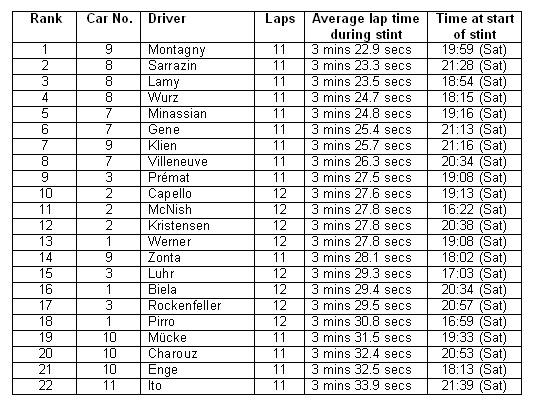
However, the experts will always tell you that it is not speed over a single lap that is important at Le Mans, but average speed over a stint that matters. So what I have done in the table below is to list out the best full stint achieved by each driver in the course of the race. I have also included, for the sake of interest, the best stints from two of the petrol-engined cars. It will be interesting to see how much “equalisation” the ACO deem necessary in next year’s regulations. I haven’t set out to name and shame anyone in particular, and of course we don’t know about the strategy that was being employed; for example if certain drivers were being told to drive to a specific target lap time. The general consensus, though, is that the Le Mans 24 hours is run like a sprint race these days, so again, I will leave it to you to draw your own conclusions, combining the information from both of these tables.
Sunday – wet and dry
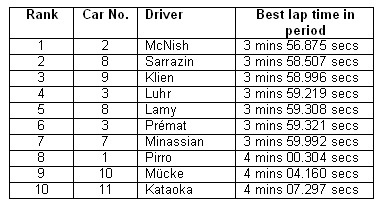
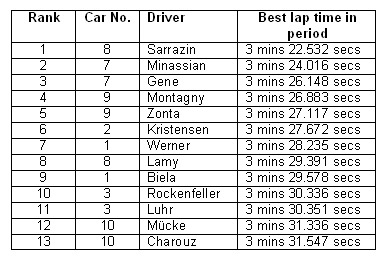
One thing that these tables do tell us though, is that the fastest part of the race was the first six or seven hours. But to win, you’ve got to be quick (at least relatively quicker than the rest) throughout the race. So I have picked some periods of the race (largely at random) to see how drivers compare against each other at different points of the race and in different conditions. So what I have done is to pick four periods of the race:
a) From 01:30 to 03:00 on Sunday morning, when it was (obviously) dark, but at least still dry, and also well past the safety car period, which ran from 00:10 to 00:42. During these 90 minutes, the only one of the leading cars not to have a driver change was the #8 Peugeot, which had Lamy driving throughout. For each car, I have shown the best time from each driver who was behind the wheel for the period. This means that the fatigue of being in the car for a long stint (for the outgoing driver), and becoming familiar with the conditions and getting up to speed (for the incoming driver) are also factors which could influence the fastest time in the period. *Villeneuve had been in the car for less than half an hour when my artificial period elapsed. It is worth noting that later in his shift (at 4:00am) he got down to 3 mins 25.371 secs. b) From 04:30 to 05:30 on Sunday morning, when it was raining (the first spots of drizzle were at 04:12 at the Tribunes), but still pretty much dark. It is my impression that the conditions during this hour were fairly consistent, and I am fairly sure (but remain open to correction) that all the listed cars were on full rain tyres (apart from Sarrazin, who was on intermediates up to 04:50). Perhaps the most noteworthy here is the performance of Zonta, who from the look of the fast laps in the dry (the first two tables), is the least quick of the Peugeot drivers, but is the quickest of them in the wet. c) From 08:30 to 09:30 on Sunday morning, when it was still very wet, but at least daylight, enabling drivers to “see the rain”. Here, it’s worth pointing out that two cars (#3 Audi and #8 Peugeot) had driver changes in the period, and the second driver in each car (Prémat and Sarrazin, respectively) was immediately able to lap close to the pace of his team-mate. d) Finally, from 12:00 to 13:45 on Sunday lunchtime, before the rain started again, when it was dry enough to warrant slick tyres, although it should also be borne in mind that the proximity of the end of the race probably led some teams (not those battling for the lead, hopefully) to consolidate their positions by running to a comfortable rhythm to the end of the race. I can sense eyes glazing over out there, so I think that’s enough numbers for now. I’m not going to spoon feed you any conclusions from this, you’re going to have to look at the numbers and decide for yourself who the “heroes” and “zeroes” of this year’s race were (at least in the top six or eight cars). But I found it immensely interesting crunching all the numbers out, and I hope you find them interesting too. Let me (via the editor) know what you think! |